






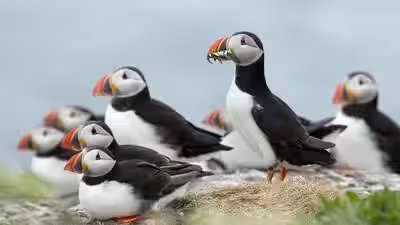
In 2002, Lundy began its rat-eradication project; puffins later rose from 13 in 2000 to 1,335, and more than 40,000 seabirds now nest on the island

Off the coast of southwest England, the small island of Lundy was once a textbook case of how invasive rats can devastate seabird colonies. By the late 1990s, puffin numbers had crashed to just 13 breeding pairs, and many other seabirds had abandoned the island altogether. In 2002, conservationists launched an ambitious rat-eradication project to…


Read More

In 2013, Czech researchers studied 70 dogs from 37 breeds and found they aligned north-south while defecating when Earth’s magnetic field was stable |

Dogs may be doing more than simply choosing a spot when they stop for a break. A 2013 study by Czech researchers found that dogs tended to align their bodies along Earth’s North-South magnetic axis while defecating, but only when the planet’s magnetic field was relatively stable. The research involved 70 dogs from 37 breeds,…

Read More

Meet Thorin Jonsson, the biologist who used 165-million-year-old insect wings to recreate the sounds of a Jurassic forest |

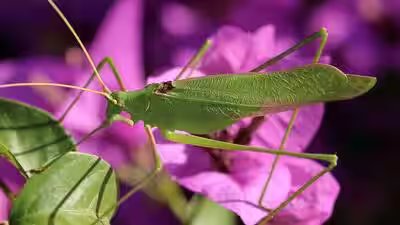
Millions of years ago, several species produced higher frequencies, just like the native leaf grasshopper. Image Credit: Thoris Jonsson/University of Graz Jurassic World was not silent. Around 165 million years ago, forests in present day Inner Mongolia were filled with the calls of insects communicating through sounds that ranged from low tones to frequencies beyond…

Read More

Meet François Génier: The Canadian Museum of Nature scientist who used animal dung to uncover three new beetle species on a remote African island |

Image: ResearchGate/François Génier Deep in the rainforests of Bioko Island, Equatorial Guinea, a deceptively simple field technique helped reveal beetles that science had never formally recognised. Canadian entomologist François Génier, from the Beaty Centre for Species Discovery at the Canadian Museum of Nature, surveyed the island’s dung beetles using traps baited with animal dung. The…

Read More

A 17-year-old Canadian student built an AI-powered water robot that uses magnetic liquid to find plastic without harming aquatic life |

Moroti Adegboyega. Image Credit: Jonas Borg / Stockholm Water Foundation A 17-year-old Canadian student has developed an AI-powered robot designed to tackle one of the most persistent forms of water pollution i.e plastic. The project, called ‘Ecoferroquatics,’ uses artificial intelligence, robotics and a magnetic liquid known as ‘ferrofluid’ to identify and remove plastic from water…

Read More

Mars winter turns carbon dioxide into snow and ice, cycling 25% of the atmosphere and changing circulation across the planet |

Winter on Mars is not simply a season of plunging temperatures and long polar nights. As the planet moves into winter, its atmosphere begins to change with it. Carbon dioxide, the dominant gas in the Martian atmosphere, can freeze directly onto the ground or fall as snow, building temporary polar caps that hold a substantial…

Read More

White storks vanished from Southern Sweden in the 1950s; a wetland revival now aims to support 100 breeding pairs |

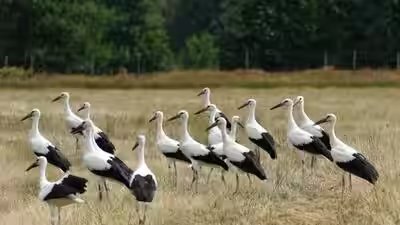
A flock of White Storks. Image Credit: Society for Ecological Restoration(SER) White storks once formed a familiar part of the landscape in southern Sweden, but by 1954 the species had disappeared as a breeding bird from the country. Their decline was closely linked to dramatic changes in the countryside, where wetlands were drained and other…

Read More

In 2019, Buffalo scientists developed a low-cost urban cooling system to reduce AC loads; tests showed 6°C cooling by day and 11°C at night |

In 2019, scientists at the University at Buffalo developed an electricity-free cooling system that uses a thin aluminium film coated with the polymer polydimethylsiloxane, or PDMS, to send heat from its surroundings through the atmosphere and towards outer space. The approach, known as radiative cooling, was designed to overcome a key challenge: making passive cooling…

Read More

Kazakhstan lost 200,000 saigas in a devastating die-off in 2015; now the population has surged past 4.6 million creating tensions with the human population |

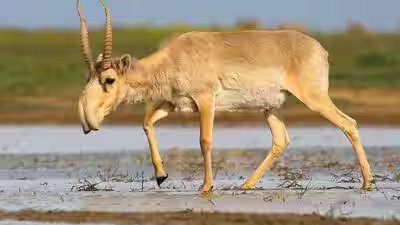
Wild saiga antelope. Image Credit: Andrey Giljov/Wikipedia In 2015, Kazakhstan’s vast grasslands became the scene of one of the most devastating wildlife losses in recent history. Around 200,000 saiga antelopes died within weeks, leaving a population already weakened by poaching and earlier declines facing another impossible setback. The disaster wiped out more than two thirds…

Read More