











Dogs may be doing more than simply choosing a spot when they stop for a break. A 2013 study by Czech researchers found that dogs tended to align their bodies along Earth’s North-South magnetic axis while defecating, but only when the planet’s magnetic field was relatively stable. The research involved 70 dogs from 37 breeds, with thousands of observations collected during walks in the Czech Republic and Germany. When the magnetic field’s direction changed more rapidly, the dogs’ body positions became increasingly scattered, and the North-South preference disappeared. The researchers found that changes in magnetic declination, the direction of Earth’s magnetic field, were a stronger predictor of the dogs’ orientation than changes in field intensity. The findings provided evidence of magnetic sensitivity in dogs and pointed towards a possible form of magnetoreception. However, the researchers could not determine how dogs detect the field or why they align themselves during excretion.
Why do dogs align north-south while defecating
When the observations were separated by the direction of Earth’s magnetic field, the researchers found a distinct pattern. During periods when magnetic declination remained stable, dogs showed a significant preference to position their bodies along the North–South axis while defecating. According to the 2013 study published in Springer Nature, titled ‘Dogs are sensitive to small variations of the Earth’s magnetic field’, this preference became more scattered as changes in magnetic declination increased. When the changes exceeded 2 per cent, the distribution became random and the directional preference disappeared.The overall results were therefore different from simply finding that dogs always face north or south. The alignment appeared specifically under relatively calm magnetic conditions. The researchers found that relative changes in magnetic declination were the strongest predictor of the dogs’ orientation, rather than changes in magnetic-field intensity. The study described this as a measurable behavioural response to natural fluctuations in Earth’s magnetic field.
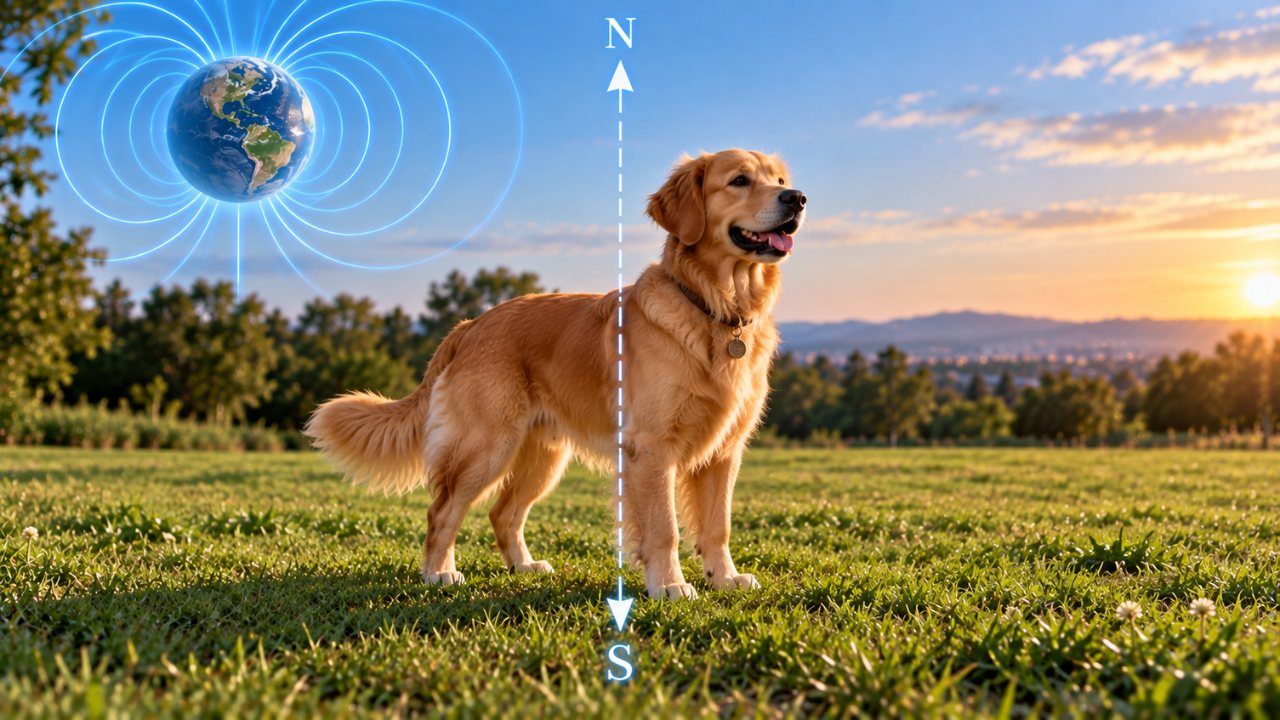
Image AI generated
Did male and female dogs show different directions
The researchers also examined the direction dogs adopted while urinating. The results again showed a relationship between body orientation and magnetic conditions. Under stable magnetic declination, the dogs showed a significant axial preference close to the North–South axis. When the magnetic field was changing, however, this directional pattern became less pronounced.There were some differences between males and females during urination. Male dogs showed a slight preference towards a North-West heading in the pooled analysis, while females showed an axial preference around the North–South axis. The researchers noted that the different posture of males while lifting a leg could have contributed to this difference. During defecation, no significant difference in alignment was found between males and females.
Dogs respond to changes in Earth’s magnetic field
The researchers concluded that the study provided evidence of magnetic sensitivity in dogs and identified a predictable behavioural response to natural changes in Earth’s magnetic field. They specifically reported sensitivity to small changes in the polarity or direction of the field rather than primarily to its intensity. The paper stated that this was the first demonstration of magnetic sensitivity in dogs and described the findings as opening new avenues for research into magnetoreception.The study did not establish how dogs detect magnetic fields or why they align their bodies while excreting. The researchers discussed possible mechanisms known from studies of other vertebrates, but stated that the reason for the behaviour remained unresolved. They also proposed that the North–South alignment might potentially relate to orientation or calibration, while noting that further work would be needed to determine the biological mechanism behind the behaviour.


