









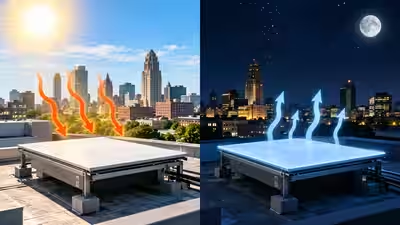
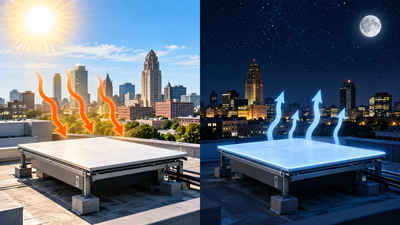
In 2019, scientists at the University at Buffalo developed an electricity-free cooling system that uses a thin aluminium film coated with the polymer polydimethylsiloxane, or PDMS, to send heat from its surroundings through the atmosphere and towards outer space. The approach, known as radiative cooling, was designed to overcome a key challenge: making passive cooling work during the day and in crowded urban areas, where sunlight can heat cooling surfaces and surrounding buildings can limit access to the sky. The researchers combined the coated film with a specially designed shelter that suppresses solar input and directs thermal radiation towards the sky. According to the University at Buffalo official press release, outdoor experiments in Buffalo showed continuous cooling of about 2°C to 9°C on a clear, sunny day. A small enclosed prototype cooled by up to 6°C during the day and 11°C at night. The researchers said the inexpensive film could be manufactured over large areas, although multiple units would be needed to cool a building.
How does Buffalo’s radiative cooling system work
Radiative cooling is particularly difficult during the day because sunlight can heat the cooling surface. The researchers therefore combined the PDMS-coated aluminium emitter with a structure designed to reduce solar input and control the direction of its thermal radiation. According to the paper published on ResearchGate, titled ‘A polydimethylsiloxane-coated metal structure for all-day radiative cooling’, the researchers developed a spectrally selective structure to “suppress the solar input and control the divergence of the thermal emission beam”, thereby making the cooling performance less dependent on the surrounding environment.The University at Buffalo researchers also focused on the problem of cooling in densely built metropolitan areas. Conventional thermal radiation can travel in many directions, meaning nearby buildings can obstruct access to the sky. Qiaoqiang Gan, an associate professor of electrical engineering, explained the approach: “Normally, thermal emissions travel in all directions. We have found a way to beam the emissions in a narrow direction.” He added that this could make the system more effective in urban environments “where there are tall buildings on all sides”.
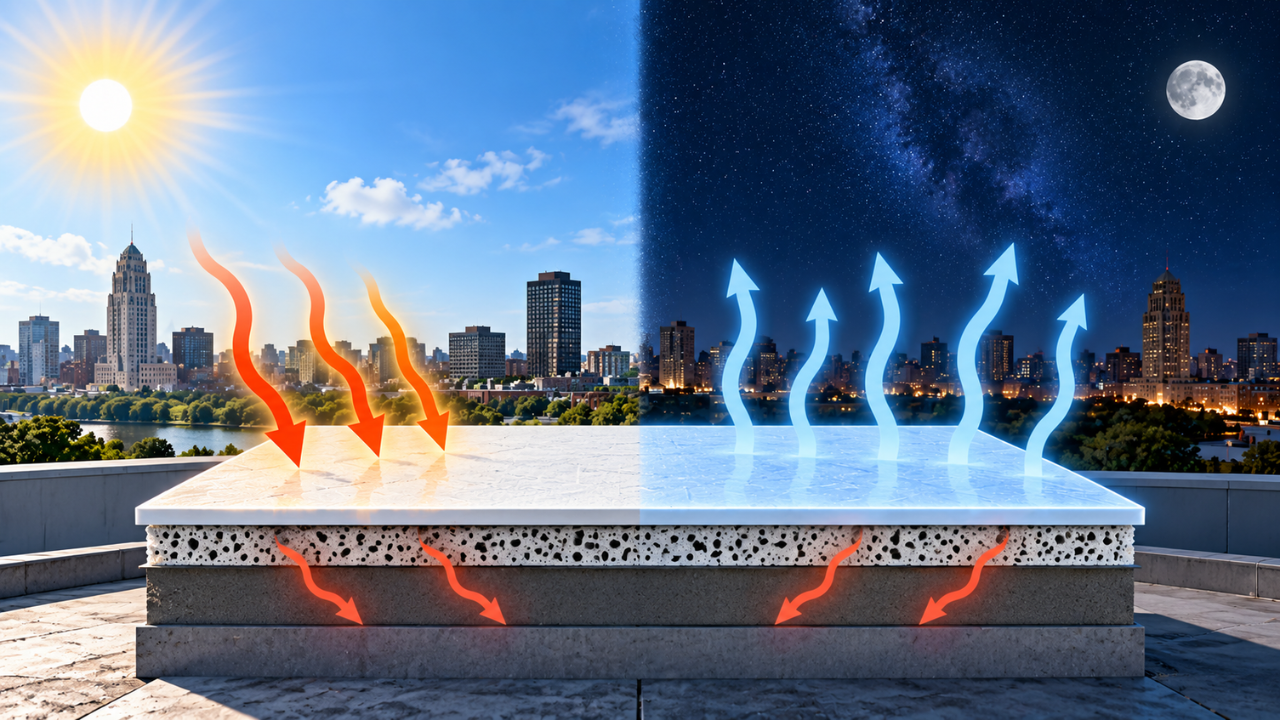
Image AI generated
What did outdoor tests reveal about radiative cooling
The researchers tested the technology outdoors in Buffalo, New York, including experiments designed to measure its performance under different conditions. The research paper reported continuous all-day cooling of about 2°C to 9°C on a typical clear, sunny day at northern United States latitudes. It also described a 50-hour continuous cooling test carried out outdoors, demonstrating that the system could operate through both daytime and nighttime conditions.The University at Buffalo release described the prototype as a compact shelter-and-box system measuring about 45.72 centimetres high and roughly 25.4 centimetres wide and long. The PDMS-coated aluminium film was positioned at the bottom of the box, while a solar shelter above it helped block sunlight and direct thermal emissions towards the sky. In the university’s outdoor tests, the enclosed space was cooled by a maximum of about 6°C during the day and about 11°C at night.
How could radiative cooling reduce AC use
The researchers chose aluminium and PDMS in part because the materials offered a relatively inexpensive route towards radiative cooling. The paper says the thin film was fabricated using a “fast solution coating process that is scalable for large-area manufacturing”. This addressed one of the challenges identified by the researchers, as some earlier thermal photonic structures had high fabrication costs and difficulties with scalability.The system was not presented as a complete replacement for conventional air conditioning. Instead, the researchers described passive radiative cooling as a way to reduce the cooling load of buildings. The University at Buffalo release noted that numerous units would need to be installed across a roof to cool a building. The research paper likewise states that radiative cooling can “reduce air-conditioning requirements”, while noting the potential significance of cooling systems that operate without electricity input.


