







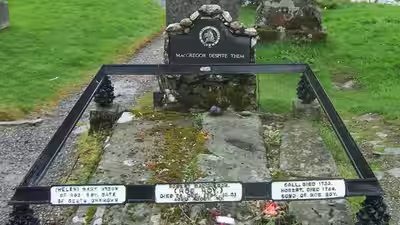
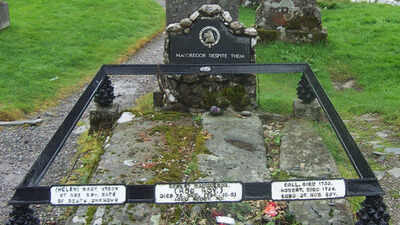
“Far and near, through vale and hill,Are faces that attest the same,And kindle like a fire new stirr’d,At sound of Rob Roy’s name”, wrote William Wordsworth in the poem Rob Roy’s Grave (1905), later to be used in an introduction of Sir Walter Scott’s novel, Rob Roy set in year 1715.Some larger-than-life heroes have been indelibly etched into stories of valour through the ages. Among the stories of the Scottish Highlands, one tale that has reverberated through time is that of Rob Roy MacGregor. His gravestone, which has been admired and visited by people for nearly 300 years, is now believed to contain carvings that may predate his death by as much as a thousand years.The discovery was made through 3D imaging of the elaborate stone slab at Balquhidder Parish Church in Scotland, where a grave believed to belong to MacGregor is marked by an elaborately carved stone slab. The imaging drew attention to carvings that appear to belong to an early period of Christian history, suggesting the stone was reused and modified over several centuries before becoming associated with the Scottish outlaw.The Balquhidder Graveyard Claymore Project, committed to documenting and studying the historic carved stones found in the churchyard, has been working to locate and identify graveslabs using photogrammetry. This is a method of creating detailed three-dimensional models using photographs, allowing researchers to examine the surfaces of gravestones more closely, record carvings and identify details that may otherwise be difficult to distinguish.In a press release published on October 30, 2026, Elaine Black of the Balquhidder Graveyard Claymore Project described the discovery as a story spanning more than a thousand years. She also suggested that Rob Roy himself might have appreciated the unusual history of the stone had he been alive to see the findings.
A gravestone with a much older history
Robert MacGregor, popularly known as Rob Roy, was a prominent figure in 17th- and 18th-century Scottish history. Often remembered as an outlaw and folk hero, his reputation grew considerably after the publication of The Highland Rogue, a fictionalised account of his life, in 1723. His story was later immortalised by Scottish novelist Sir Walter Scott in his 1817 novel Rob Roy, helping establish the image of the Highland figure in popular culture.When MacGregor died in 1734, he was buried at Balquhidder Parish Church, where an elaborately carved stone slab is believed to mark his resting place. However, archaeologists had already suspected that the stone was considerably older than the eighteenth century and had been reused for a later burial.According to Archaeology Magazine, in an article published on November 9, 2026, the recent 3D imaging revealed a cross-like carving near the top of the stone that appears to belong to the early medieval period. The design has been interpreted as possibly depicting a flabellum, a ceremonial fan that was once used during Catholic religious services. The unusual carving is accompanied by two smaller crosses on either side, adding to the possibility that the stone originally belonged to an early medieval religious setting.
What the carvings reveal
The identification of the possible flabellum is particularly interesting because it offers a clue about the person for whom the stone may initially have been created. A flabellum was a ceremonial object used in Catholic liturgy, and its depiction on a carved stone could suggest an association with the clergy. Researchers therefore believe that the slab may originally have been made for an important cleric connected to the early medieval church.Dr Kelly Kilpatrick, who identified the fan-like design during a recent site visit, also drew attention to the two smaller crosses positioned alongside it. These have been carved using a technique known as pocking and smoothing, which is characteristic of early Christian sculpture. The arrangement of three crosses is also a familiar feature of early medieval stonework, with the largest representing the cross on which Jesus Christ was crucified.However, the stone did not remain unchanged throughout its history. The carvings appear to have been added at different periods of time, with some of the more recognisable images belonging to a much later phase. These include a sword, a pair of tongs and what may be a scene depicting hunting or herding, which are believed to have been added sometime during the fifteenth or sixteenth centuries.There is also a carved figure that has been interpreted as a possible depiction of Rob Roy himself, shown with a kilt and shield. Interestingly, even this image may have been adapted from an older medieval carving, rather than being made specifically to represent MacGregor. This means that the slab could have undergone several rounds of modification before it was eventually placed over the grave believed to belong to him.The project has also been making these digital models available online, allowing people to become part of the exploration of the carvings and inscriptions. With the recently revealed archaeological evidence, the history of this gravestone now offers an insight into a past that was not previously understood, tracing a story that predates the very hero it has come to epitomise.