







North Dakota has taken an important step towards restoring the Red River of the North by changing a dam that once restricted fish movement. The modification at Drayton Dam created a passage through which fish can move more freely, reconnecting stretches of river that had long been difficult to reach. The project forms part of a wider conservation effort to bring lake sturgeon back to their historic habitat. According to the US Army Corps of Engineers and fisheries researchers, the restoration is helping improve river connectivity while supporting the recovery of native fish populations.
How Drayton Dam restoration reopened the Red River to lake sturgeon
The Drayton Dam project marked a significant milestone in efforts to restore fish movement across the Red River basin. As reported by the American Fisheries Society Fisheries Management Section, the structure was modified in 2023 to create a rock-rapids passage for fish.Before the work, Drayton Dam was the last major unmodified barrier on the American stretch of the Red River’s main channel. Although fish could sometimes cross it during high water, the structure restricted movement during much of the year, particularly when fish needed to travel upstream towards spawning habitat.The modification replaced the traditional barrier with a passage made from rocks and cobbles arranged to create flowing sections and pools. This design allows fish to navigate through the structure rather than having to overcome the abrupt drop associated with the former dam.The American Fisheries Society noted that the project was part of a broader restoration programme aimed at reconnecting the river and its tributaries. By improving access to previously restricted areas, fisheries managers hoped to give lake sturgeon and other species a better opportunity to reproduce naturally.
Why lake sturgeon disappeared from the river basin
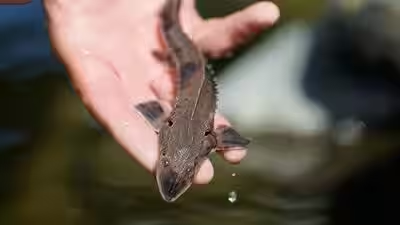
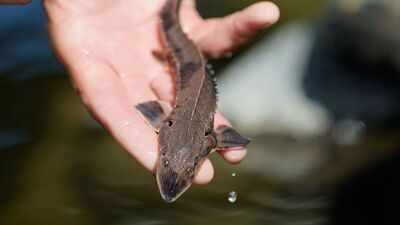
Lake sturgeon are among North America’s oldest freshwater fish species. They can live for more than a century, grow to considerable sizes and take many years to reach reproductive maturity. Their long life cycle makes population recovery particularly challenging when numbers fall sharply.According to the US Fish and Wildlife Service, lake sturgeon populations suffered severe declines around the turn of the 20th century. Overharvesting, widespread killing and changes to river systems contributed to their near disappearance from many waters.The International Joint Commission also identified dam construction as a major reason for the historic decline of lake sturgeon in the Red River basin. Barriers disrupted migration routes and prevented fish from reaching important spawning and nursery areas.By the middle of the 20th century, lake sturgeon had disappeared from much of the Red River basin. Their return has required more than simply releasing young fish into the water. Conservation programmes have also needed to restore the conditions that allow the species to survive and reproduce independently.
What evidence shows that the restoration is working
The US Army Corps of Engineers’ St Paul District described the return of lake sturgeon spawning in the Red River basin after more than 100 years.The report noted that biologists documented the first spawning in the basin in 2022 and observed spawning at multiple locations in subsequent years. These observations indicated that reintroduced fish were surviving, reaching maturity and beginning to reproduce without relying entirely on stocking programmes.The findings were especially important because lake sturgeon mature slowly. The North Dakota Game and Fish Department has explained that males may require a decade or more to become capable of spawning, while females can take well into their late teens or early twenties.
Fish are being tracked across the Red River system
Restoring passage is only one part of the work. Researchers also need to understand whether fish are actually using the newly accessible stretches of river.The International Joint Commission reported that a long-running fish tracking study had detected important species moving across substantial parts of the Red River system. The project, which began in 2016, uses radio and acoustic tags attached to fish and a network of listening stations to record their movements.Around 250 tracking stations were being used across the Red River, Lake Winnipeg and the Assiniboine River. Researchers monitored lake sturgeon alongside species such as bigmouth buffalo, channel catfish, walleye and freshwater drum.The findings showed that lake sturgeon tagged near the Otter Tail River, close to the Red River’s headwaters, had travelled downstream through the river system and reached Lake Winnipeg.The International Joint Commission also reported that 41 of 77 major barriers in the watershed had been modified or removed by 2023. The Drayton Dam modification added another important passage to this growing network.In December 2024, the commission reported that fish were moving through much of the Red River system following the installation of passage structures. However, researchers were still analysing data to determine how effectively fish were using the new Drayton Dam passage.
Partnerships remain central to sturgeon recovery
The Drayton Dam project was completed through cooperation between several public agencies and regional partners.According to the US Army Corps of Engineers, the $7.7 million project was connected to the Fargo-Moorhead Metropolitan Area Flood Risk Management Project. The dam modification also addressed a longstanding safety concern because low-head dams can create dangerous currents and underwater circulation that pose risks to people using the river.The Corps’ September 2024 completion announcement highlighted the involvement of North Dakota and Minnesota agencies, the Metro Flood Diversion Authority, the North Dakota Game and Fish Department and the city of Drayton.The collaboration brought together flood management, public safety and conservation objectives. The new structure improved fish passage while retaining opportunities for recreational fishing along the river.The North Dakota Game and Fish Department has also been expanding restoration efforts beyond the main river. In November 2023, it reported that fisheries personnel released 1,000 young lake sturgeon into the Pembina River, a tributary in northeastern North Dakota.The fish were released to re-establish a population in a river where sturgeon had been absent for a long time. Officials stressed that the effort would take years to evaluate because the fish needed to grow and mature before they could reproduce.
What comes next for the Red River sturgeon population
The American Fisheries Society’s project spotlight described the second phase of the Red River lake sturgeon restoration plan, covering 2019 to 2029.The priorities include identifying spawning locations, monitoring population growth, assessing whether fish can reproduce successfully without continued stocking and removing additional barriers across tributaries.The Minnesota Department of Natural Resources and its partners have stocked more than 580,000 lake sturgeon fingerlings in the Red River basin as part of the recovery programme.The US Fish and Wildlife Service has also emphasised the cultural importance of lake sturgeon to Indigenous communities across North America. The species has long been valued for its role in traditional food systems and cultural practices, making its recovery significant beyond ecological restoration.