





Total solar eclipse on August 12, 2026: When and how to watch the rare ‘sunset eclipse’ and the best locations to see it |

Total Solar Eclipse. Image Credit: Bob Linsdell/Wikipedia On 12 August 2026, a total solar eclipse will take place, which will cross the Northern Hemisphere from Siberia to the Mediterranean. This rare celestial event is expected to attract millions of observers from many continents. The path of totality (the narrow track or strip of land where…


Read More

In 1977, a Saudi prince towed an Alaskan iceberg to Iowa to pitch shipping icebergs to Arabia for drinking water; now engineers are exploring the idea as freshwater scarcity worsens

The royals across the world are known to pull numerous extravagant moves with an aim to impress. While Cleopatra made guests dine on gold plates, King Henry VIII of England and King Francis I of France built temporary palaces of brick and glass for a meeting. But in modern times, such grand gestures have been…

Read More

In Rio de Janeiro’s Guanabara Bay, discarded salon hair is being transformed into an oil-absorbing barrier that protects mangroves from oil spills

When scientists have a will, there is always a way. In a shocking yet successful project, leftover hair from haircuts that is not suitable for wigs and would have gone to waste is now being used to prevent oil and other pollutants from getting into the water and the trees.In Rio de Janeiro’s Guanabara Bay,…

Read More

In 1868, a solar eclipse in India revealed a mysterious element in the Sun that would not be found on Earth for 27 years |

In August 1868, the Sun briefly became a laboratory for astronomers gathered in India to watch a total solar eclipse. Among them was the French astronomer Pierre Jules Janssen, who turned a spectroscope towards the bright prominences rising around the eclipsed solar disc. Their light contained a yellow spectral line that seemed to sit close…

Read More

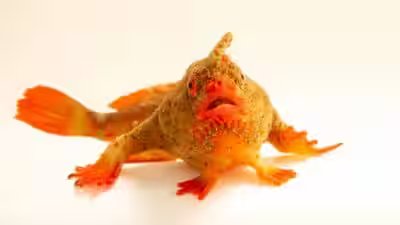
Photo Ark: Meet the red handfish, the critically endangered ‘walking’ fish that became Photo Ark’s 18,000th species

A critically endangered female red handfish, Thymichthys politus. (Photo: Joel Sartore) For 20 years, photographer Joel Sartore has been building a huge visual record of the world’s animals. His project, called the Photo Ark, has now reached another major milestone with its 18,000th species- the critically endangered red handfish. The milestone photo was announced by…

Read More

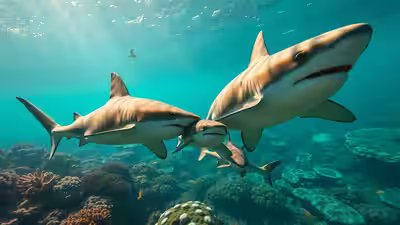
Bull sharks in Fiji repeatedly meet at the same reef, and scientists found they slightly prefer spending time with relatives |

Representative Image of bull sharks gathering at a coral reef and displaying social behavior (AI-generated image) Bull sharks have long been viewed as solitary hunters that cross paths mostly by chance, but a six-year study in Fiji suggests otherwise. Researchers observed adult bull sharks gathering repeatedly at a single reef site and found that individuals…

Read More

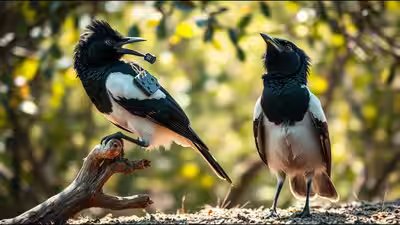
Gps: Scientists fitted Australian magpies with GPS trackers, but the birds quickly learned to remove them for each other |

Representative Image of Australian magpies cooperating to remove tracking devices from one another (AI-generated image) Researchers in Queensland fitted five Australian magpies with tiny GPS trackers, hoping to map their movements and understand how age, sex or rank affected the way the flock behaved. The birds had other plans. Within about ten minutes, an untagged…

Read More

2,300-year-old beer, well preserved inside an ancient bronze bottle containing nearly a gallon of liquid with more than 2,400 chemical compounds, was discovered by archaeologists |

Archaeologists in China have uncovered an extraordinary alcoholic drink that remained remarkably well preserved for more than 2,000 years inside an ancient bronze bottle. The vessel, recovered from a Qin-period tomb at the Shanjiabao cemetery in the Ningxia Hui Autonomous Region, contained about 3.74 litres of pale blue-green liquid, equivalent to nearly a gallon. Scientific…

Read More

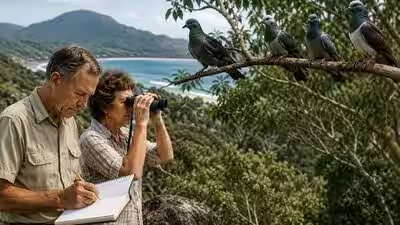
In 1965, a couple began counting pigeons in Queensland. Three years later, numbers fell from 4,692 to 1,451, beginning a 60-year conservation story |

A couple, Margaret and Arthur Thorsborne, travelled north from Queensland’s Gold Coast to Hinchinbrook Island, a place they knew largely through photographs. They would return many times, eventually making the Cardwell area their home and becoming closely associated with its forests, wetlands and wildlife. Among the animals that caught their attention were pied imperial-pigeons, which…

Read More