







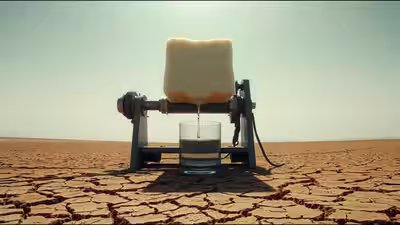
German scientists made a sponge-like material that pulls drinking water from air as dry as 18% humidity, producing up to 1.8 litres per kg each day |

Representative Image of water harvesting technology collecting and storing water (AI-generated image) Researchers at Kiel University in Germany have developed a highly porous material that can pull drinking water directly out of dry air, offering a possible lifeline for regions where rainfall is becoming less reliable. The material, known as CAU-10-H, behaves like a sponge,…

Read More

Quote of the day by Benjamin Franklin: “What is more valuable than gold? Diamonds. Than diamonds? Virtue.” |

Benjamin Franklin (Image: Wikipedia) Two people can spend a lifetime accumulating whatever they consider valuable and end up with completely different kinds of wealth to show for it. One collects money, property, and possessions, each one clearly priced, each one able to be counted. The other spends that same effort building something that resists being…

Read More

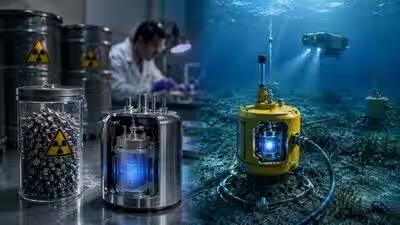
America is turning decades-old radioactive waste into strontium-90 power systems that could keep underwater sensors running for decades |

America is quietly building a network of nuclear-powered nodes on the ocean floor that could charge drone submarines for close to three decades without a cable, a support ship or a single resupply run. The fuel behind this project is strontium-90, a radioactive by-product that has sat in government storage for decades, and the Pentagon…

Read More

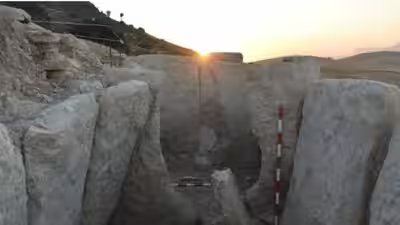
Archaeologists in Málaga uncovered a 13-metre megalithic tomb more than 5,000 years old; ivory, amber and seashells point to long-distance exchange networks

Photo credit: University of Cádiz Archaeologists working near Teba in Málaga, southern Spain, have uncovered a remarkably well-preserved megalithic tomb that is more than 5,000 years old. Announced by the University of Cádiz, the structure, known as Dolmen I of the La Lentejuela necropolis stretches about 13 metres, or roughly 42 feet, and contains multiple…

Read More

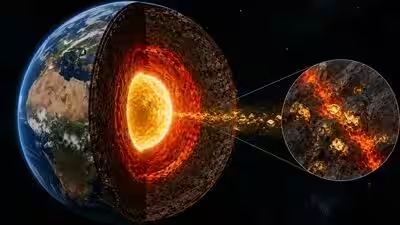
Earth’s core contains most of the planet’s gold, and scientists now find evidence that some core material is leaking into the mantle |

Earth’s core holds far more gold than anyone can reach. More than 99.999 per cent of the planet’s stores of gold and other precious metals lie buried under 3,000 kilometres of solid rock, locked away within the metallic core and far beyond the reach of humankind. For decades, geologists assumed this vast reserve was permanently…

Read More

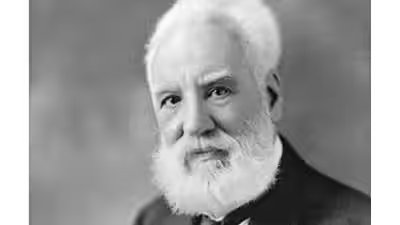
Quote of the day by Alexander Graham Bell: “Great discoveries and improvements invariably involve the cooperation of many minds” |

Alexander Graham Bell is best remembered for helping develop the telephone, an invention that transformed how people communicated across distance. Yet Bell himself recognised that major breakthroughs rarely belong entirely to one person. His statement, “Great discoveries and improvements invariably involve the cooperation of many minds”, reflects the collaborative nature of scientific progress. Bell worked…

Read More

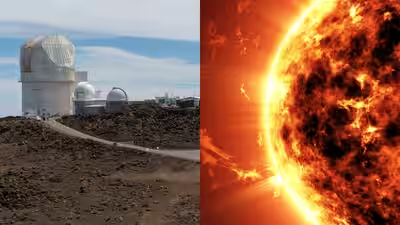
The world’s largest solar telescope resolved the Sun at about 19-km scale and revealed ubiquitous plasma vortices that may help explain how magnetic energy moves

The observations were made with the Daniel K. Inouye Solar Telescope (DKIST), a powerful 4-metre class solar telescope operated by the US National Science Foundation. The Sun may appear to us on Earth as a glowing ball of plasma, but its surface is far more active and turbulent than it looks, which has been proven…

Read More

Wyoming’s Casper landfill buried 1,124 turbine blades after each was cut into three pieces; a Missouri plant offers another route by turning old blades into cement feedstock

Outside Casper, pieces of turbine blades cut through were lowered by a loader into a trench for years. Now, what they are being used for instead of being buried under the ground, is to make cement powder. And this transition is worth noting.The Casper Regional Landfill took its first decommissioned blades in the spring of…

Read More

Newborn German cockroaches eat from a shared fecal pile and learn their colony’s smell; the social bond may explain why traps often fail

The discovery may also help explain why conventional traps and insecticidal baits can sometimes have trouble controlling infestations. why cockroach traps fail, how German cockroaches find their colony, how cockroach pheromones work, why cockroaches gather in groups, newborn cockroaches learn colony smell, cockroach feces used to identify colony members, using pheromones to control cockroach infestationsCockroaches…

Read More

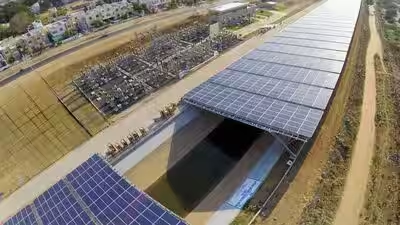
A half-mile solar strip floats above an irrigation canal in Gujarat, generating 1.6 million kilowatt-hours of power while saving 2.38 million gallons of water from evaporation

When it comes to solar panels, they are usually spread across rooftops or open fields where they serve more purposes than just providing energy. But near Chandrasan village in the western Indian state of Gujarat, a roughly 2,460-foot ribbon of panels sits above moving irrigation water, turning an existing canal into both a power site…

Read More