








For nesting penguins in Antarctica, finding food is no longer just about how many fish or krill are in the ocean. It is also about how difficult those animals are to catch.Scientists who tracked more than 6,000 penguin dives beneath Antarctic sea ice found that prey can become much harder to reach even when their overall numbers have not fallen. Instead of eating their food until it nearly disappears, the repeated presence of hunting penguins causes krill and fish to change their behaviour, moving deeper into the water or spreading out to avoid the birds. This forces penguins to work much harder to find food.The study, published on July 15 in the Proceedings of the Royal Society B, changes how scientists understand predator-prey relationships in extreme environments. It suggests that how easy prey is to reach is just as important for survival as how much food is available.
The mystery of the empty zones
For many years, scientists have studied a phenomenon called Ashmole’s halo. This is an area around large seabird colonies where food appears to become scarce.Traditionally, researchers believed this happened because thousands of birds living in one place simply ate most of the nearby prey. As a result, the birds had to travel farther from the colony to find enough food.“Traditionally, this pattern has been mainly explained by prey depletion: predators consume prey near the colony, reducing prey abundance,” said Hina T. Watanabe, a postdoctoral scholar at the National Institute of Polar Research in Japan. “However, prey may also become harder to catch if they change their behaviour or distribution in response to predators.”Because it is extremely difficult to observe these small and rapid underwater interactions, scientists have had very little direct evidence showing how predators change the behaviour of their prey.To investigate, Watanabe and her team studied breeding Adélie penguins in East Antarctica. The bay around the colony was covered by thick sea ice, meaning the penguins could only enter and leave the ocean through a small number of shared holes in the ice. This concentrated their hunting activity in the same locations.
Measuring dives in three dimensions
The researchers fitted the penguins with advanced bio-logging devices. These trackers recorded the birds’ movements, dive depths, and feeding events in detailed three-dimensional data, supported by video recordings.Altogether, the team collected information from 30 foraging trips, tracking 23 penguins across more than 6,000 dives beneath the sea ice.The results showed a clear pattern. Each time penguins repeatedly entered the water through the same opening, they had to dive deeper and swim farther under the ice to find prey during each new dive.However, once they reached the krill, they fed just as successfully as before. If the krill had been heavily depleted, the penguins would have found fewer of them and their feeding rate would have dropped. Instead, they continued feeding at the same speed, but had to spend more time searching because the krill had moved away from the area where the penguins were hunting.
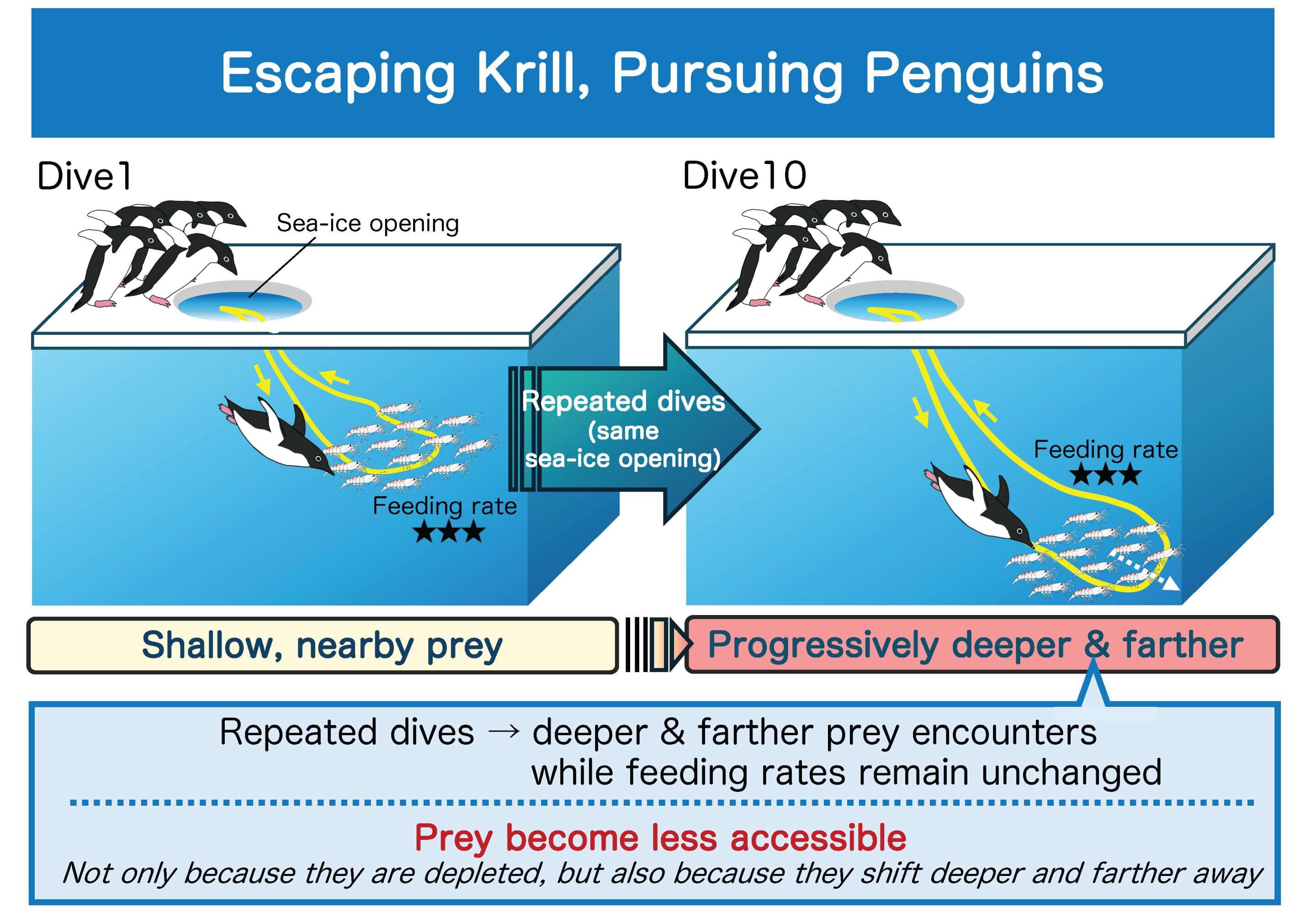
Schematic illustration showing how repeated dives from shared sea-ice openings lead penguins to encounter krill progressively deeper and farther beneath Antarctic sea ice while feeding rates remain unchanged.
The same pattern was found across the breeding colony. Penguins searching for food close to the nesting site had to make much deeper and longer dives than those feeding farther away, even though the surrounding waters still contained plenty of krill.“Food can become harder to obtain even when it has not necessarily been depleted,” Watanabe said. “We found that penguins had to dive progressively deeper and farther to encounter prey, but once prey were encountered, feeding rates remained unchanged. This suggests that prey accessibility, not only prey abundance, can shape predator foraging patterns. Because repeated diving activity is concentrated near breeding colonies, local prey displacement may accumulate over time, contributing to functional prey depletion, where prey remain present but become progressively less accessible.“
How chinstrap penguins hunt at twilight
This dependence on prey accessibility is also supported by recent research on other penguin species. In the Scotia Sea, scientists tracked 45 breeding chinstrap penguins from two colonies on Monroe and Powell Island during 2022 and 2023.By combining tracking information with underwater acoustic surveys of krill, the researchers found that chinstrap penguins plan their daily hunting around the vertical movements of their prey.Antarctic krill move up and down in the water every day. During daylight, they stay in deeper water to avoid predators that hunt by sight. At night, they rise closer to the surface to feed on tiny algae.Chinstrap penguins take advantage of this behaviour by doing most of their hunting at dawn and dusk. As the krill begin moving upward, the penguins travel farther offshore to hunt these dense groups.From an evolutionary perspective, this allows the penguins to gain more energy while using less effort. Catching krill near the surface requires much less energy than making deep dives into cold water during the day.When chinstrap penguins hunted during daylight, they stayed closer to the colony and made much deeper dives to reach the krill. This creates an energy trade-off, as the adult birds must balance the effort of deep diving with the need to quickly return and feed their hungry chicks.
The target is the swarm, not the biomass
he chinstrap study also found that penguins do not always hunt where the total amount of krill is highest. Instead, they often choose areas with lower krill numbers if the prey is within an easier diving depth.This suggests that finding a single, easy-to-catch swarm of krill matters more to a hunting penguin than the total amount of krill spread throughout the water. This strategy also helps chinstrap penguins avoid direct competition with Adélie and gentoo penguins, which mainly hunt during the middle of the day.Understanding these detailed hunting behaviours is becoming increasingly important as climate change, recovering whale populations, and human activity continue to reshape the Southern Ocean. Warmer ocean temperatures and shrinking sea ice threaten krill breeding grounds, while commercial fishing fleets harvest krill in many of the same areas where penguins search for food.For conservationists, understanding how and when penguins reach their prey is essential. If warming seas push krill deeper or fishing activity scatters them across the ocean, penguins could struggle to find enough food even if plenty of krill still remains in the water.


