


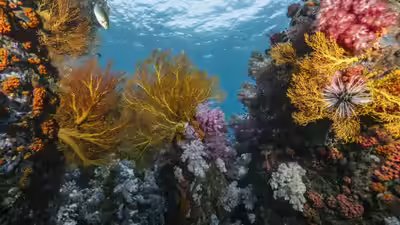
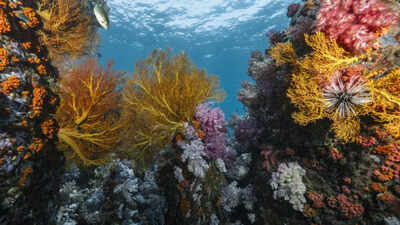
An international team of scientists has mapped more than 64,000 square miles of coral reefs that can withstand severe heat stress. The findings provide a vital plan for saving marine life while the world’s oceans experience their worst bleaching crisis ever recorded.The study used artificial intelligence to analyze decades of environmental data. The AI identified specific underwater sanctuaries across 71 countries and 100 territories. These areas have unique natural features that shield, insulate, or help coral ecosystems recover from marine heatwaves.The research was presented at the Our Ocean Conference in Mombasa, Kenya, and published on the preprint server EcoEvoRxiv. The findings challenge the common scientific belief that coral reefs cannot be saved. Instead, the new maps show exactly where governments should spend conservation money to protect marine life.“Coral reefs are often framed as ecosystems beyond saving,” study co-author Emily Darling, director of coral conservation at the Wildlife Conservation Society, said at the conference. “This research shows otherwise.”
Using computers to find climate sanctuaries
Coral reefs cover only 1 per cent of the ocean floor but support a quarter of all marine life. They are vital for global food supplies and protect coastlines from storms. Their biggest threat is rising water temperatures, which cause mass bleaching.When seawater gets too warm, corals expel the tiny, colorful algae that live inside them. This strips the corals of their main food source. It leaves them bone-white, highly stressed, and likely to die from starvation or disease.To find habitats that can survive this heat, researchers defined three types of natural havens, known as climate refugia:
- Avoidance refugia: Areas with physical traits, like cold-water currents, that shield corals from heat.
- Resistance refugia: Areas where corals have naturally evolved to handle higher temperatures.
- Recovery refugia: Areas where corals might bleach but are healthy enough to grow back quickly.
Darling and her team trained an AI model to look for these three types of sanctuaries. They fed the computer roughly 45,000 coral observations recorded since 1960. The system looked at 42 separate environmental factors, including water chemistry, temperature shifts, and local human activity.The AI model evaluated global maps to predict coral health for the year 2050. The results showed that these resilient reefs are highly concentrated. About 61 per cent of these safe zones are located in the waters of just five nations: Australia, the Bahamas, Cuba, Indonesia, and the Philippines.The models also discovered brand new, highly resilient reef zones in Belize, Nicaragua, and the Turks and Caicos Islands. This expands on the data from the 2018 “50 Reefs” study, which was the first major effort to find heat-resistant corals.
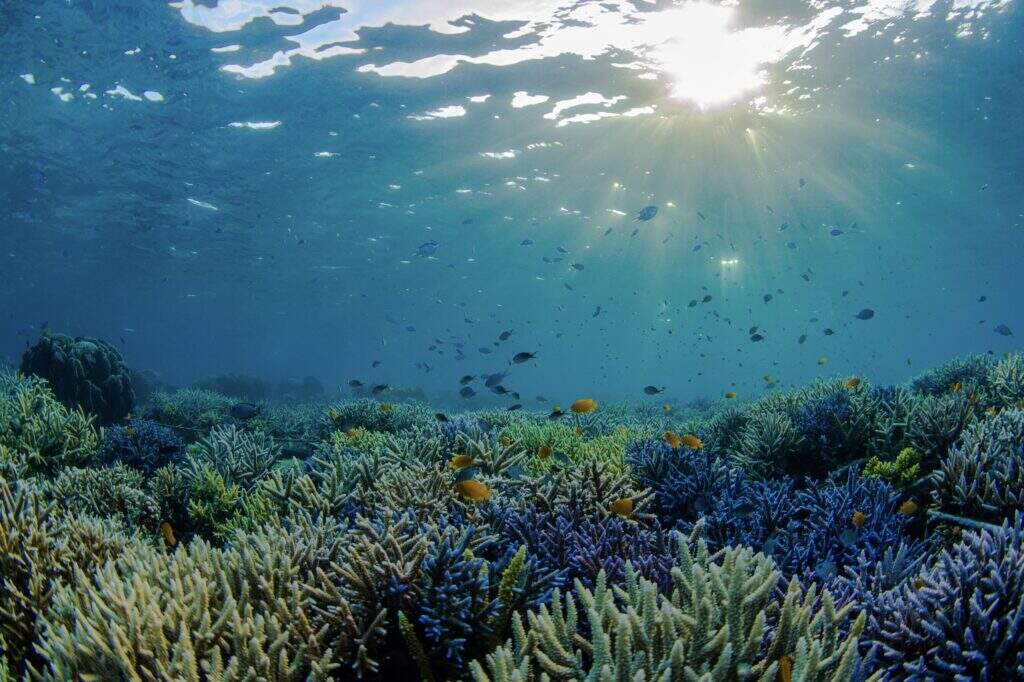
Coral reefs and their associated ecosystems
A plan for targeted conservation funding
Finding these specific zones provides a clear plan for environmental groups. This is especially helpful for small island nations that do not have the money or resources to protect all of their waters.“Climate-resilient reefs are not spread evenly,” study co-author Joseph Maina, an environmental scientist at Macquarie University in Australia, said at the conference. “And countries need to understand … those differences such that when they plan where future conservation investment should go, they consider this uneven distribution.”Independent scientists have welcomed the precision of the new data. They note that it changes the focus from simply recording the destruction of the oceans to actively saving them.“This study sharpens decades of work on reef resilience to climate change,” says David Obura, a marine ecologist and the chair of the Intergovernmental Platform on Biodiversity Ecosystem Services, who was not part of the research team. “It focuses attention on the critical question: Will climate refuges comprise 10 percent, 1 percent or even less of the former extent of coral reefs?”However, local conservationists in these newly found safe zones say the results must be treated carefully. Alizee Zimmermann, the executive director of the Turks and Caicos Reef Fund, wants to examine the data closely because her region has lacked long-term monitoring. She warned that the good news should not make governments complacent.“The narrative that Caribbean reefs are simply ‘dead’ is inaccurate and can be harmful to progress on reef restoration and protection initiatives in the region,” Zimmermann stated. “However, it would be equally disingenuous to say that they are thriving.”
A backdrop of global destruction
The discovery of these resilient pockets comes at a time of extreme urgency. According to a report by the National Oceanic and Atmospheric Administration (NOAA) and the International Coral Reef Initiative, more than 80 per cent of the world’s reefs have suffered bleaching-level heat since 2023. This makes it the worst global bleaching event in history.Mass die-offs have struck the tropics. Florida’s reefs suffered severe heat in 2023, causing 100 per cent bleaching across the Florida Keys. In 2024, Australia’s Great Barrier Reef faced catastrophic bleaching. Extreme damage has also been recorded in the Persian Gulf, the Red Sea, and wide parts of the Caribbean.The current crisis has surpassed the previous record set between 2014 and 2017, when 70 per cent of global reefs were exposed to extreme heat. Melanie McField, founder of the Healthy Reefs for Healthy People initiative, described the eerie sight of a heat-damaged reef.“There is usually an absence of fluttering fish and an absence of the vibrant colours on the reef,” McField said. “It’s an ashen pallor and stillness in what should be a rowdy vibrant reefscape.”
Navigating uncharted waters
Because the current marine heatwave is still happening, scientists do not know when water temperatures will drop enough for corals to heal.“We may never see the heat stress that causes bleaching dropping below the threshold that triggers a global event,” warned Mark Eakin, the corresponding secretary for the International Coral Reef Society. “We’re looking at something that’s completely changing the face of our planet and the ability of our oceans to sustain lives and livelihoods.”Britta Schaffelke, a researcher at the Australian Institute of Marine Science, agreed that the sheer size of the heatwave takes marine ecosystems into completely uncharted waters.Yet, supporters of the new mapping study point out that corals have survived major extinctions throughout Earth’s history. If these specific safe zones are protected from overfishing and pollution, the corals can eventually spread and repopulate other areas.“The ancestors of today’s corals survived the impact of the asteroid that wiped out the dinosaurs on land and a lot of creatures in the sea,” says Joerg Wiedenmann, a marine biologist at the University of Southampton. “So, if we manage to decrease ocean warming, there is always a chance for corals to recover.”In the long run, saving these newly mapped areas depends on global political action to cut greenhouse gas emissions. Valeria Pizarro, a senior coral scientist at the Perry Institute for Marine Science, stressed that world leaders must invest heavily in clean energy and reduce fossil fuel use to give these sanctuaries a real chance.However, these protections face immediate political hurdles in the United States, where the Trump administration has moved to increase fossil fuel production and reduce clean energy initiatives. Coral researchers view these political changes as a direct threat to global conservation.“Removing these protections is going to have devastating consequences,” Eakin said.


