






Have you ever imagined where the gods might have had their resting places? Perhaps somewhere nestled among the high mountains, with sweeping views of the vast expanse of land below, where distances seem almost infinite. It is an image that poets across the world have often conjured for us, long before we could imagine such places for ourselves.For the ancient Greeks, these mountainous landscapes could also be places of worship, where people made their way through difficult terrain to seek a connection with the divine. While mountaintop sanctuaries are not entirely uncommon in archaeological excavations across Greece, a new discovery has now brought one such place to light.The Swiss School of Archaeology in Greece (ESAG), in its annual report dated November 9, 2026, reported that archaeologists had excavated a previously identified site on the summit of Elatias, on the Euboean Mount Olympos, confirming the existence of an ancient mountaintop sanctuary.Their investigations uncovered a remarkably rich collection of pottery and animal bones, indicating that the site was used for religious purposes from the Geometric period through to the Roman Imperial era. The discovery was also reported by Tom Metcalfe in Live Science on November 24, 2026, drawing on email correspondence with excavation leader Chloé Chezeaux.
A sanctuary without a temple
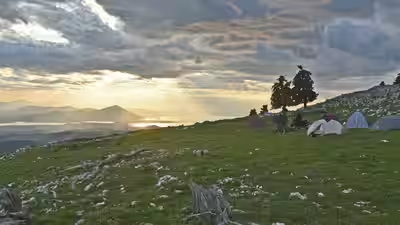
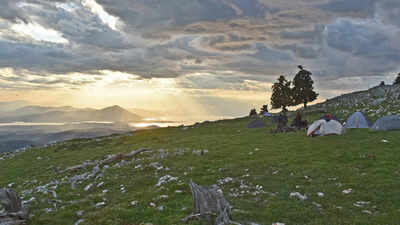
The discovery was made on the Greek island of Euboea, located approximately 50 kilometres northeast of Athens. The site lies near the summit of Elatias, one of the highest peaks of Mount Olympos, at an elevation of approximately 1,138 metres. It is worth noting that this is not the famous Mount Olympus on mainland Greece, traditionally believed to be the home of the ancient Greek gods, but another mountain bearing the same name.Interestingly, unlike the grand temples and elaborate religious complexes that often come to mind when one thinks of ancient Greek worship, this sanctuary appears to have had no buildings at all. No temple structures have been identified at the summit, making the concentration of archaeological material all the more significant.An archaeological survey carried out in 2025 first led the team to identify indications of the site, before the first excavation took place in 2026. As Chezeaux explained to Live Science, mountaintop sanctuaries are not particularly unusual in ancient Greece. However, identifying them can frequently leave archaeologists with more questions than answers, given the scarcity of archaeological evidence and the fact that some sites have no visible structures at all.
Pottery, animal bones and centuries of offerings
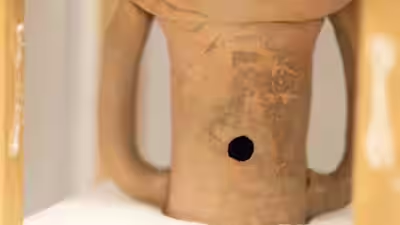
Among the most striking discoveries was an exceptional concentration of pottery, with the earliest pieces dating back to at least the ninth century BC, approximately 2,900 years ago. The assemblage includes different types of pottery, suggesting that the site may have been used for a range of activities associated with religious gatherings, offerings and feasting.The archaeological evidence indicates that worshippers continued visiting the summit over several centuries, potentially for more than a thousand years. The sanctuary appears to have remained in use until the first or second century AD, during the Roman Imperial period. Much of this activity is believed to have been associated with people from the nearby ancient city of Eretria, although researchers caution against assuming that every visitor necessarily came from there.The pottery was not the only evidence of ritual activity. Archaeologists also discovered animal bones, particularly those belonging to sheep and goats, in crevices around the site. Several of these showed signs of burning, with some having been exposed to particularly high temperatures. Chezeaux told Live Science that these remains suggest practices involving animal sacrifice and ritual meals, both of which played an important role in ancient Greek religious traditions.
Was the sanctuary dedicated to Artemis?
So far, archaeologists have not found an altar, nor have they established which god or goddess the sanctuary was dedicated to. Zeus, the principal deity in ancient Greek mythology, was traditionally associated with mountains and elevated places, making him one possible figure to consider.However, researchers have also raised the possibility of a connection with Artemis, the Greek goddess associated with the wilderness, hunting and wild animals. This possibility emerged from an ancient inscription found in Eretria that referred to ‘Artemis Olympia’, suggesting a plausible connection between the goddess and the mountain. This has led researchers to consider whether the sanctuary might have been a destination for her worship.
Why make the difficult journey?
Perhaps one of the most fascinating aspects of the discovery is the effort required to reach the sanctuary. Even today, reaching the summit is no easy undertaking. Chezeaux told Live Science that the final stretch of the ascent involves walking approximately three kilometres, with an elevation gain of around 650 metres.It is difficult to establish how long the journey would have taken ancient worshippers, particularly because the routes they followed and the conditions under which they travelled remain unknown. Still, the physical challenge raises an interesting question: what made people return to this particular mountain over so many generations?When it comes to archaeological discoveries, conjecture often remains at the centre of what we know. Even with a comprehensive survey helping researchers identify the sanctuary, it is crucial to remember that its exact purpose, religious significance and, essentially, the meaning that ancient Greeks ascribed to this place remain uncertain. Whether they climbed the mountain in search of a particular deity, to leave offerings or simply to participate in religious gatherings, the existing archaeological evidence cannot yet provide all the answers. Perhaps, for now, the mountain still holds some of its secrets.