









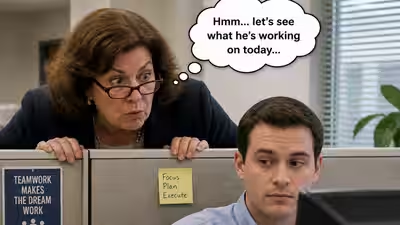
We all have been in situations where we get a glance over the shoulder and a “quick check-in” text, or a message asking, “Any update?”, feels like a familiar pinch of being watched at work.Even though it may seem like diligence, a manager who checks often appears to care about results. But human behaviour has an old trick: what we do and why we do it do not happen for the same reason.Sometimes a controlling person appears responsible, but for some, keeping an eye on everything is the only way to calm the fear that things might fall apart. In that case, the watching is not really about the other person’s work. It is about the watcher’s own worry.But that often sends the opposite message to the person receiving it.Let us find out the psychology behind a manager who constantly checks in on subordinates.
What constant checking says about control and trust
According to the NeuroLeadership Institute, a global research organization and leadership consultancy, attendance once gave managers certainty that the team was working, and that certainty vanished when the workforce went remote. The organisation mentions a study in which 74 percent of bosses said “remote work made them feel a lack of control over their business.” It argues that this feeling can come across as a threat, which may push some managers towards closer monitoring.According to a London School of Economics report sponsored by Microsoft, “The Future Role of Trust in Work,” work has become more mobile and less visible, so managers use mobile technology to check in on workers.
How does this impact trust?
A 2017 study of 3,015 employees found that monitoring was linked to lower felt trust, while having control over decisions was linked to higher felt trust. Felt trust also fully explained why monitoring was connected to lower intrinsic motivation and a weaker sense of mastery. So being watched tends to make people feel less trusted, and feeling less trusted drains the drive to do good work.
The mental toll of constant check-ins
Research from NEOMA Business School, co-authored by Professor Birgit Schyns, surveyed 450 UK employees. It found that when working from home, people who are monitored too often can feel they have less autonomy and are under constant surveillance, especially when managers behave unpredictably. Daily monitoring leaves remote workers “wondering why their managers are making such frequent demands,” and some end up physically and mentally exhausted.
Does it even work?
The NeuroLeadership Institute reports a study in which certain kinds of monitoring reduced undesirable behaviour somewhat but did very little to promote effective behaviour. Watching may stop the worst, but it rarely creates the best.So, checking in is not always a bad thing and could be done just to keep things in order, but too much of it can be misconceived. When a manager keeps watching, people stop feeling trusted. When a manager chooses trust over control, people feel safe and valued, and they usually do their best work without being pushed.