









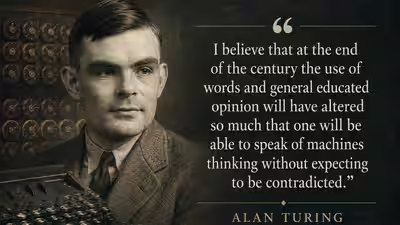
Many years before the existence of artificial intelligence was discussed among people, Turing questioned the possibility of machines having the ability to think in the future. In an age where computing devices were huge, experimental gadgets mostly used for computations, he envisioned a world in which people would talk of machine intelligence and find nothing strange with the notion. Turing conveyed his prediction in his now-famous words: “I believe that at the end of the century the use of words and general educated opinion will have altered so much that one will be able to speak of machines thinking without expecting to be contradicted.”Alan Turing (1912-1954) was a British mathematician, logician and computer scientist whose work laid much of the theoretical foundation for modern computing and artificial intelligence. During the Second World War, his codebreaking work at Bletchley Park played a crucial role in deciphering German communications. He later developed ideas that helped shape the emerging field of computer science.
Quote of the day by Alan Turing
“I believe that at the end of the century the use of words and general educated opinion will have altered so much that one will be able to speak of machines thinking without expecting to be contradicted.”
What does this quote mean
Turing is talking about how people’s perception regarding machines will change in the future. Rather than believing that thinking is the preserve of humans, people may one day be ready to accept that machines are able to show signs of intelligence. The important thing here is that Turing is not only talking about machines; he is also talking about people and the way their perceptions will evolve.
Turing imagined a future others could barely see
When Turing discussed machine intelligence, there were no computers as we know them now. However, he was not confined by the technology of his era. He understood that machines can perform many tasks other than arithmetic calculations, provided that they were programmed to process information, to act upon instructions, and to learn from mistakes. Such ability to go beyond the current technological limitations has become one of the distinctive traits of Turing’s work.
Intelligence does not always look human
One interesting implication of Turing’s proposition is whether one has to think just like a human being in order for him to qualify as intelligent. Computers can analyse massive amounts of data and detect patterns in them which can help them solve certain problems faster than any human being. Although their skills may not be like ours in any way, they can achieve results that are definitely intelligent in nature.
Society’s definition of intelligence can change
Ideas that once seemed impossible can become ordinary when technology catches up with imagination. A machine translating languages, recognising speech or generating text would once have sounded like science fiction to most people. Today, such capabilities are increasingly familiar. Turing understood that technological change could gradually alter the language people use and the assumptions they make about what machines can do.
The real question may be what we mean by “thinking”
Another point made by Turing raises some very fundamental philosophical issues as well. If a computer is able to generate a smart response, then does it mean that it is truly thinking? What does it mean to think? Is it the thought process of getting to the right answer, or comprehending meaning, or being conscious, or something completely different altogether? These issues still await resolution.
From theoretical idea to everyday reality
What makes Turing’s prediction particularly striking is how closely parts of it resemble the world we live in today. Artificial intelligence now appears in search engines, smartphones, scientific research, healthcare, education and creative tools. People routinely discuss whether machines can reason, learn or create. The conversation Turing imagined has moved from the pages of scientific thought into everyday life.
Why this quote still matters today
AI has progressed much further than most individuals in Turing’s time could ever have dreamed, but his question remains unanswered. It is easy to create machines capable of doing more complex things than before, but it is even harder to define what intelligence actually means. Turing was right that when a technology revolutionises society, it revolutionises thinking as well; his words serve to show this. The main idea of Turing’s question is that the most significant innovation does not consist in making machines learn something new, but in changing our thoughts.


