


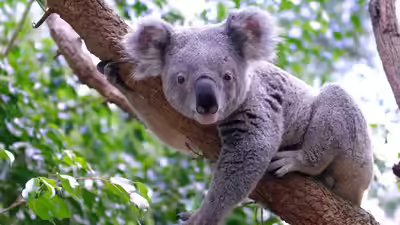
A major genetic study has found that koalas almost became extinct about 100,000 years ago because of major climate changes, long before the first humans reached Australia.By studying the DNA of hundreds of koalas, an international team of researchers found that every koala alive today came from a very small group of survivors that lived through severe ice ages. The findings, published in the journal Molecular Biology and Evolution by Oxford University Press, change the accepted timeline of the species and show that its earliest major population crisis was caused by natural climate change, not human activity.A team led by the University of Sydney and Texas A&M University studied 457 koala genomes to trace how the marsupial population declined and recovered over thousands of years.To improve accuracy, the scientists measured the koala mutation rate for the first time by examining genetic changes across four parent-offspring trios. This showed that the koala’s genetic clock runs at about half the speed of the human genetic clock.
A flawed historical timeline
Earlier studies suggested that koala numbers dropped mainly after modern humans arrived in Australia around 65,000 years ago. Those studies used general mutation rates taken from distant relatives such as mice and humans.Fossil evidence from the late Pleistocene period is too limited to show exactly how many koalas once lived across Australia. By measuring the true mutation rate in koalas, the researchers were able to look into the past by using genetic diversity as a guide to their history.Toby Kovacs, the PhD student who led the research at the University of Sydney, explained how genetic evidence helps fill the gaps left by the fossil record.“The study rewrites the timeline for the koala’s genetic history in Australia,” Mr Kovacs said. “By calculating the mutation rate of modern koala populations, we can estimate and build the genetic timeline backwards all the way to 100,000 years ago to get a glimpse of genetic diversity and the sizes of ancient koala populations.”The new timeline shows that the population first began to decline about 100,000 years ago and reached a major genetic bottleneck around 60,000 years ago. This is the first time scientists have directly measured the mutation rate of any member of the Diprotodontia order, which includes wombats, kangaroos, and possums.
The survival of the eastern group
The major population decline happened during a period of dramatic environmental change across Australia. Millions of years ago, the continent was covered with thick, wet forests. As the Australian tectonic plate slowly moved north, the climate became much drier.During the Pleistocene epoch, Australia repeatedly shifted between cold, dry ice ages and warmer, wetter periods. These repeated changes made the land drier and increased the risk of large bushfires.About 70,000 years ago, the Nullarbor Plain expanded into a huge dry shrubland. This geographic change separated koalas in Western Australia from those living in the east.The isolated western populations eventually disappeared as their habitat continued to shrink. However, one small group survived the harsh glacial conditions in the eastern forests.When the climate became warmer between 16,500 and 6,000 years ago, this eastern group began to recover. As forests returned, the koalas spread out again and separated into five genetically distinct groups, forming the basis of the modern koala populations found today along Australia’s eastern coast.Mr Kovacs said the team now plans to apply the same genetic approach to other native Australian animals.“Given these results, we’re now curious to see if other Australian species, including the closest relatives of extinct megafauna, also experienced population declines before humans arrived,” Mr Kovacs said.
Modern dangers and future protection
Although the ancient population collapse was caused by natural ice ages, researchers stressed that the threats facing koalas today are very different. Since 2022, koalas have been officially listed as endangered in Queensland, New South Wales, and the Australian Capital Territory.Current estimates show that while koala numbers in Victoria are beginning to recover, populations in New South Wales and Queensland are still declining. Today, koalas face many human-related threats, including land clearing, dog attacks, vehicle collisions, bushfires, and outbreaks of chlamydia.Mr Kovacs said the new genetic findings will help conservationists identify populations that are at risk of inbreeding before the problem becomes too serious.“Genomic analyses show that koalas have experienced major population declines in the past due to climate change and habitat loss. When environmental conditions improved, their populations recovered and expanded across much of eastern Australia,” Mr Kovacs said.“It’s important to make clear many of the threats facing modern koala populations are caused by humans, which includes habitat loss and hunting.”“Understanding whether koala populations are shrinking helps conservationists act early, before populations lose genetic diversity and face increased risks from inbreeding,” he added.“Koalas experienced large population retractions in the past, as the climate changed and suitable habitat disappeared. The surviving koalas are again experiencing a similar retraction, but this time due to human-driven land clearing, bushfires, hunting and disease.”“Our team is generating enormous genomic resources for koalas, but to fully understand what these datasets can tell us, we also need to know how quickly new genetic changes arise in the species,” Mr Kovacs said. “Estimating the mutation rate improves our ability to reconstruct koala population history, understand their capacity to adapt, and make more informed conservation decisions for the future.”


