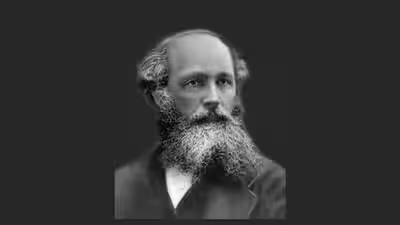







Quote of the day by James Clerk Maxwell: “Happy is the man who can recognise in the work of today a connected portion of…” |

In the process of striving for our long-term objectives, it may be easy to lose sight of the significance of the tasks at hand. However, James Clerk Maxwell provided a different outlook, stating that even regular work could be associated with an ideal much bigger than the situation itself. He says, “Happy is the man…

Read More

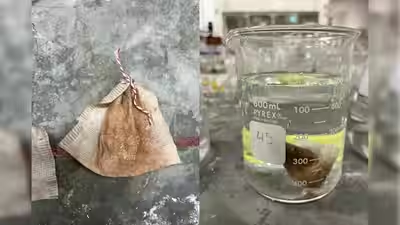
Meet Vick Tan: The Minnesota student who turned a teabag into a low-cost filter that removed more than 90% of arsenic from water |

A small teabag may not seem like much of a solution to polluted drinking water, but for Minnesota student Vick Tan, it became the centre of a science project that went far beyond the classroom. Tan helped develop a simple-looking pouch designed to capture arsenic from contaminated water, using a mix of cellulose fabric, crushed…

Read More

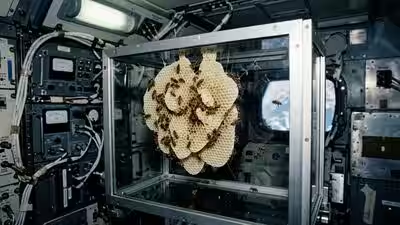
In 1984, NASA sent thousands of honeybees into space to build a honeycomb without gravity, and the tiny colony eventually created 31 square inches of comb |

A small box of honeybees once became an unusual passenger aboard the space shuttle Discovery. In 1984, Nasa sent thousands of honeybees into orbit to see how they would behave when gravity was no longer guiding their movements. The experiment was less about honey and more about a basic piece of bee life: building a…

Read More

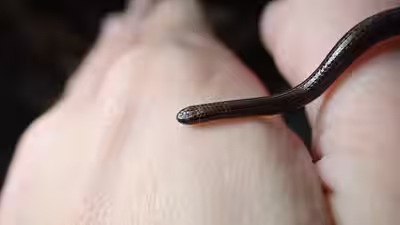
Scientists overturned hundreds of rocks in Barbados and finally found the world’s smallest snake after 20 years |

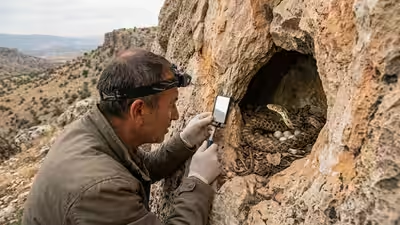
After nearly 20 years without a confirmed sighting, scientists in Barbados have finally rediscovered the world’s smallest-known snake. According to the Associated Press, the tiny Barbados threadsnake was found beneath a rock during an ecological survey in central Barbados, bringing an end to a search that had seen researchers turn over hundreds of rocks in…

Read More

Freezing liquid inside optical fibre makes light and sound interact more than 1,000 times more strongly

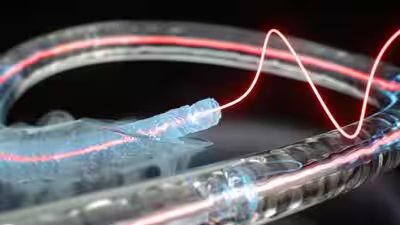
Representational photo of a frozen optical fiber core in a glass capillary, which guides and couples light and sound waves efficiently. (Science Daily picture) Freezing liquid inside an optical fibre has helped scientists create an unusual environment where light and sound can interact more than 1,000 times more strongly than they do in ordinary optical…

Read More

In 2005, crickets were fertilised aboard the ISS; 112 embryos and larvae were studied, and the microgravity-exposed larvae hatched earlier than ground controls

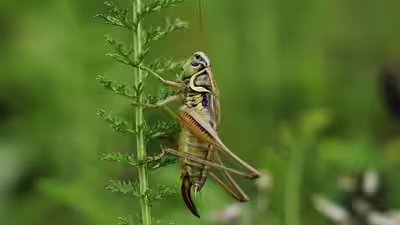
Cricket on a plant (Image Credit: Canva) In 2005, scientists conducted an unusual experiment aboard the International Space Station (ISS) to investigate how microgravity affects reproduction and early development. According to a NASA technical publication on ISS research, crickets were fertilised in orbit, allowing scientists to observe embryos and larvae that began developing under microgravity….

Read More

In 2011, conservationists dropped 75 tonnes of poisoned bait on Henderson Island; only about 60–80 rats survived, but within two years their population was back to roughly two-thirds of its former level

Henderson Island (Image credit: Canva) In 2011, Henderson Island, a remote and uninhabited island in the South Pacific, became the site of one of the largest rodent-eradication attempts ever undertaken on an island of its size. Conservationists spread about 75 tonnes of poisoned bait across the island in an effort to eliminate invasive Pacific rats,…

Read More

Chinese humanoid robots just beat Usain Bolt’s 100m record and the human high-jump record, are humans already losing to machines?

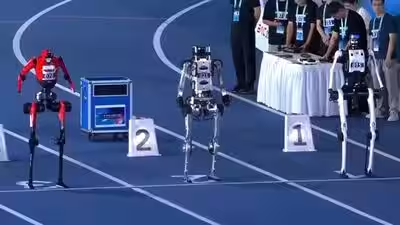
It seems technology is already outrunning humans not only in algorithms but also on the field. At a 100-meter sprint at the Beijing Robot Games, a humanoid robot is said to have beaten the human record of Jamaican athlete Usain Bolt. The robot named Lightning Bolt, achieved a result of 9.39 seconds, beating Bolt’s record…

Read More

Scottish Water: Scotland recycles 72,000 contaminated single-use plastic bottles in a world-first move as new technology targets Petri dishes and pipette tips |

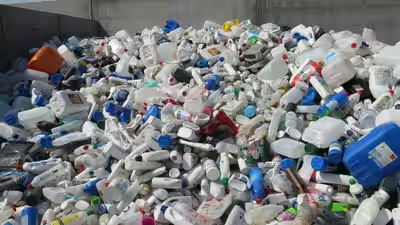
Scotland is taking a new approach to laboratory plastic waste. A new recycling system has already processed around 72,000 contaminated plastic sample bottles. The technology is now being expanded to Petri dishes and pipette tips. Scottish Water has become the first utility in the world to adopt Envetec Sustainable Technologies’ GENERATIONS technology. The system disinfects…

Read More