



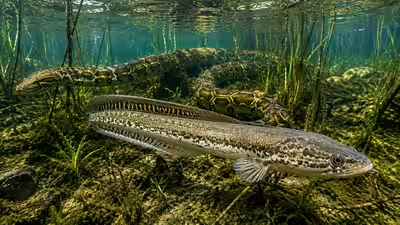
Since the 1980s, Florida’s biggest threat has been Burmese pythons; but this snake-like fish may be even worse for the Everglades ecosystem |

In Florida’s canals and wetlands, some of the most consequential changes are difficult to see. An Asian swamp eel can spend much of its time buried in mud or hidden beneath vegetation, emerging to feed when water returns. That makes it very different from the Burmese pythons that have become a familiar symbol of the…
Read More

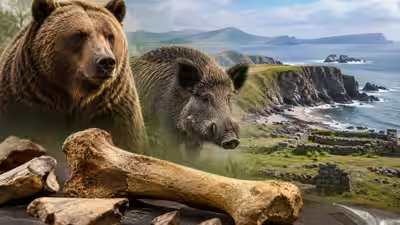
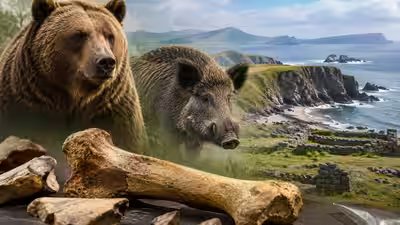
For 30 years, the “Kerry cow” bones were seen as proof of early farming in Ireland; scientists now say they belonged to a bear and wild boar

Representative Image (AI-generated) For more than three decades, a collection of animal bones from Ireland’s Ferriter’s Cove was considered some of the earliest evidence that farming had reached the island. But new research has now overturned that interpretation. According to University College Dublin (UCD), bones once identified as cattle have instead been identified as belonging…

Read More

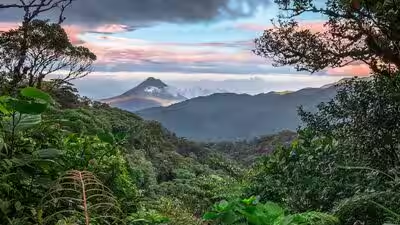
In 1972, Costa Rica began protecting a misty mountain forest: Decades later, Monteverde’s 10,500 hectares have become a remarkable conservation story |

High in Costa Rica’s Tilarán mountains, the forest often appears to be suspended between land and sky. Mist moves through the trees, settles on leaves and mosses, and becomes part of the water moving down the slopes. At Monteverde, that moisture is not simply a feature of the scenery. The forest sits along the Continental…

Read More

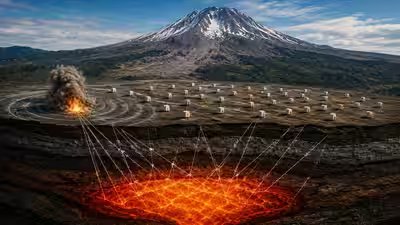
In 2014, scientists set off 23 explosions and deployed 3,500 seismographs around Mount St Helens; the experiment helped image a magma reservoir roughly 4 to 15 km beneath the volcano

Representative Image (AI-generated) Mount St. Helens is one of the most closely studied volcanoes in the United States, but scientists still cannot directly see the complex system of magma and rock hidden beneath it. In 2014, researchers launched an ambitious experiment to change that. According to the Imaging Magma Under St. Helens (iMUSH) project, a…

Read More

Scientists reidentify Ireland’s famous “Kerry Cow” bones as ancient bear and wild boar remains, challenging a long-held theory about how farming reached the island

Representative Image (AI-generated) For more than three decades, a collection of animal bones from Ireland’s Ferriter’s Cove was considered some of the earliest evidence that farming had reached the island. But new research has now overturned that interpretation. According to University College Dublin (UCD), bones once identified as cattle have instead been identified as belonging…

Read More

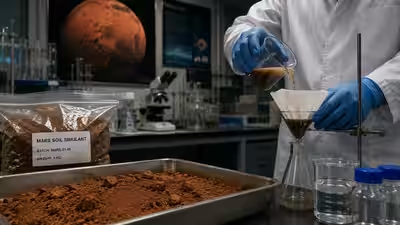
Meet Jeremiah Bents, the Minnesota student who recreated Mars soil in a lab to test whether future astronauts could clean contaminated water |

Mars may be millions of kilometres from Minnesota, but for Cloquet student Jeremiah Bents, one small part of a future Mars mission could be tested much closer to home. Instead of looking at how to reach the Red Planet, Bents turned his attention to what astronauts might do once they get there, particularly when dealing…

Read More

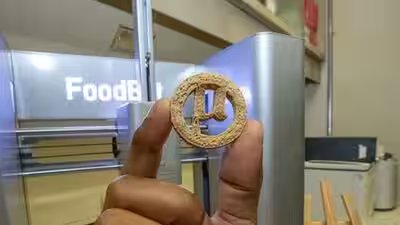
Scientists turned plastic bottles and corn waste into protein-rich cookies; the food could help tackle hunger problem and also feed space crews

The technology could also potentially be used in places such as submarines and future human settlements on the Moon or Mars (American chemical society photo) Researchers at Southern Illinois University Carbondale (SIU Carbondale) are working on a technology that turns plastic waste from a water bottle into part of a cookie. For this, they programmed…

Read More

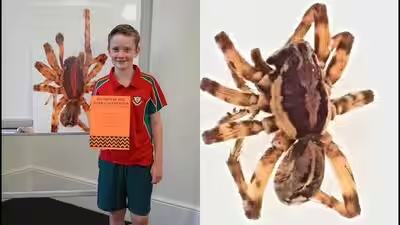
In 2020, 10-year-old Murphy Widdowson collected a spider on a remote Australian island that experts could not identify; scientists later declared it a new species and named it Artoriopsis murphyi after him

While on the remote island Murphy picked up a small spider that intrigued him, and he decided not to wonder what sort of spider he’d found, but to seek the opinion of an expert. For most kids, finding a spider would be a scream, and then a quick retreat. But for Murphy Widdowson, it was…

Read More

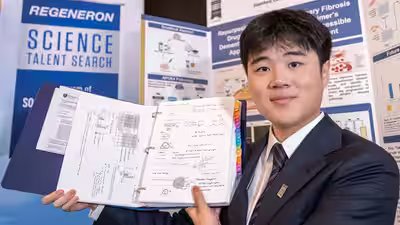
Meet Leon Wang, the 17-year-old Connecticut student who found 2 FDA-approved drugs that reduced Alzheimer’s-linked damage in lab-grown brain cells

Leon Wang, the 17-year-old Connecticut student (Image Credit: Society For Science) Alzheimer’s disease remains one of the most difficult neurological disorders to treat, partly because the processes behind it can begin damaging brain cells long before symptoms become apparent. Now, a project by 17-year-old Connecticut student Leon Wang has drawn attention for exploring whether medicines…

Read More

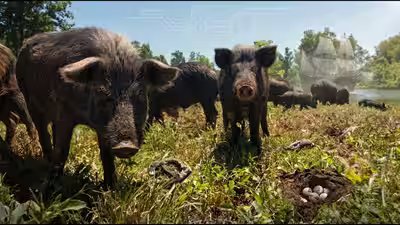
In the 1500s, Spanish explorers left pigs on a Georgia island as future food; centuries of feast and famine produced hogs that rapidly store fat and are now used to study obesity and metabolic disease

Ossabaw Island Hogs (Representational Image Generated using AI tool) Centuries ago, Spanish explorers sailing along the coast of what is now the United States brought pigs with them as a practical food supply. Some escaped, while others were deliberately released so future expeditions would find animals waiting when they returned. On Ossabaw Island, a barrier…

Read More