








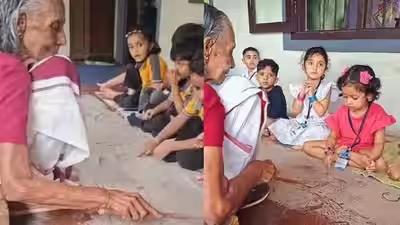
There are no notebooks, pencils or blackboards in Indira Amma’s classroom. Instead, an elderly woman spreads a layer of sand on the ground, smooths it with a small stick and begins writing letters for children sitting in front of her. They watch her movements and then use their own fingers to trace the same shapes in the sand.At 85, Indira Amma from Kerala is still teaching young children through this traditional method. For nearly a decade, she has been helping them learn Malayalam, Hindi, English and mathematics using little more than sand and a stick.As reported by The Better India, she teaches at the Temple of English School, where children gather around her to practise writing. Known affectionately as Ashaatti Ammumma, she has continued using a method that connects early learning with Kerala’s traditional educational practices.A video of her teaching, shared on Instagram by the account Mom of Safachiiii went viral all over the social media recently. The video shows her preparing the sandy surface and demonstrating letters to the children. As she writes, the children follow her movements and practise the same letters with their fingers.
How children learn by writing in sand
The method is simple. Indira Amma spreads sand over a flat surface and uses a stick to draw letters and numbers. Children observe how each character is formed before attempting to reproduce it themselves. If they make a mistake, the surface can be smoothed again and they can start over. Unlike writing in a notebook, the exercise does not require a fresh sheet of paper every time a child wants to practise.The children learn through watching, tracing and repeating the movements. They can become familiar with the shape of a letter by following its lines with their fingers rather than only looking at it on a page. The method also allows repeated practice without wasting paper.For young learners who are just beginning to write, this gives them an opportunity to make mistakes and try again without worrying about spoiling a notebook.
A practice rooted in Kerala’s learning traditions
Indira Amma’s teaching method draws on Kerala’s traditional practice of introducing children to writing through sand or rice. According to The Better India, the practice is connected to Ezhuthiniruthu, a ceremony traditionally associated with Vijayadashami, when a child is guided to trace their first letters as a symbolic beginning to education.The practice reflects an older way of introducing children to literacy, before notebooks and modern classroom materials became common. Children would learn by tracing letters on a surface of sand or rice, guided by a teacher.A 2005 report by The Christian Science Monitor also documented the use of sand-writing in Kerala’s traditional ‘kalari’ learning spaces. It described young children practising Malayalam letters and numbers in sand as part of their early education. The report quoted a volunteer explaining that he, too, had learnt this way, as had his father.This method is also associated with the traditional ‘Aashan Kalari’ system, in which teachers introduced children to basic reading and writing through repeated practice. While the names and rituals associated with these traditions may vary, the use of sand as a writing surface has been part of Kerala’s educational history.
Teaching more than one language
Indira Amma’s lessons cover Malayalam, Hindi and English, along with mathematics. Children are introduced to letters and numbers through demonstrations and repeated practice. The approach is not limited to memorising characters. Children have to observe the way a letter is written, understand its shape and then reproduce it themselves. This gives them an active role in the lesson.The lessons offer a way to practise basic writing without relying on digital devices or expensive learning materials. However, the sand exercise is best understood as an early learning activity that can complement formal education, rather than a replacement for books and classroom instruction.Indira Amma’s lessons have attracted attention because they show a familiar teaching practice being used with young children today. Her work also brings attention to the role of traditional learning methods in early education. As reported by Malayala Manorama, the children at the Temple of English School in Alappuzha sit in a row while she writes letters in the sand for them to copy.At 85, Indira Amma continues to teach children using a method that needs no complicated equipment. She prepares the sand, demonstrates each letter and gives the children time to practise it themselves. For the young learners, the ground becomes a writing surface that can be erased and used again. For Indira Amma, it is a way to continue a teaching tradition that has been passed down through generations.