


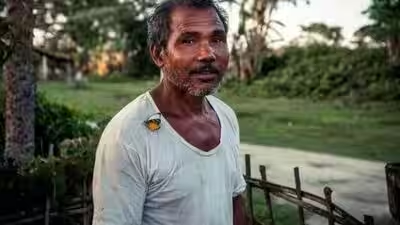

On a remote stretch of sand in Assam’s Brahmaputra River, this person spent decades doing something that seemed almost invisible at first. Day after day, Jadav “Molai” Payeng planted trees on land that had been damaged by erosion and changing river patterns. There was no large campaign behind the effort, no immediate recognition, and no guarantee that the saplings would survive. Years later, the empty landscape had transformed into a thriving forest supporting birds, animals and plant life. The story of India’s “Forest Man” is not just about planting trees, but about patience, persistence and a changing relationship between people and nature.
How Jadav Payeng started planting trees and created a forest on Majuli Island
Payeng’s relation to nature goes back to his childhood days spent in Majuli, the river island in Assam. When he was a teenager, he witnessed an event that impressed him greatly: Several snakes had died due to exposure to the hot weather conditions in a completely denuded piece of land.He wondered why the environment was so vulnerable. For a very long time, Majuli suffered from problems that arose because of strong currents of the Brahmaputra River that slowly destroyed the territory of the island. Payeng found it unacceptable just to sit and observe how nature is being destroyed.As reported by OneEarth, in 1979, he started planting trees. He planted small saplings of trees into the parched earth and looked after their growth day by day. This activity continued for many years. There was no certainty about the survival of those plants, but this activity became a regular part of his life.At the beginning, the future forest was nothing more than scattered greenery on a vulnerable patch of land. Over time, the trees created conditions for more plants to grow, allowing the area to develop into a much larger ecosystem.
How Jadav Payeng’s trees changed the landscape of Majuli
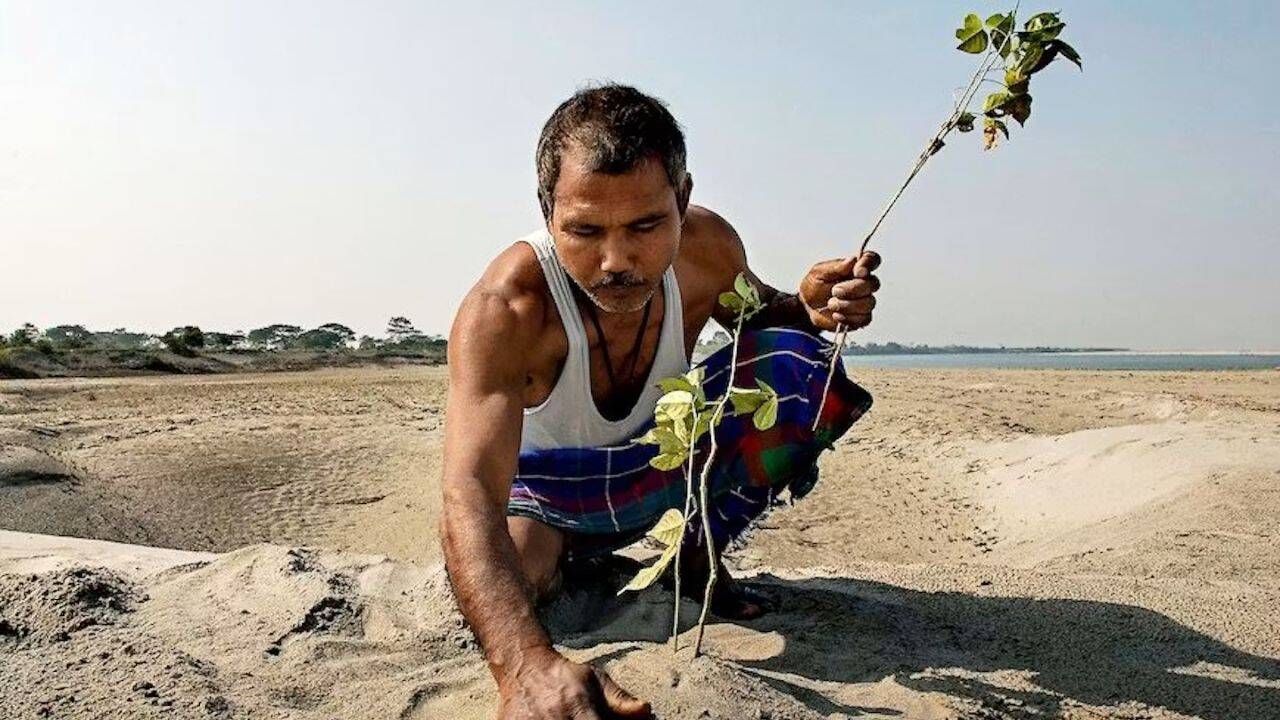
PC: OneEarth
The forest created by Payeng is one which has spread across thousands of hectares of land on Majuli. Starting off as one with bamboo and small plants, the forest has grown into one which is dense and has many different kinds of plants.With the forest growing into a dense cover of plants, many wild animals started to come back there. There are many birds and animals that live in the forest, which includes deer, rhinos and others. The elephants of the region are also known to visit here once a year.This was very important because the area around Majuli was always filled with uncertainties. The Brahmaputra river keeps changing its course, and Majuli has always faced erosion over the years. The forest acted like a safe place for soil, plants and animals.Payeng’s work did not involve creating a planned forest in the traditional sense. Instead, it developed slowly through years of planting and allowing nature to take its own course.
How Jadav Payeng became known as India’s Forest Man
For many years, few people outside his village knew about Payeng’s work. That changed in 2007, when photographer and journalist Jitu Kalita came across the forest while documenting Majuli.The discovery brought national attention to a man who had spent decades working largely alone. Stories about his unusual journey spread across India, and Payeng became widely known as the “Forest Man of India.”His efforts later earned him several honours, including the Padma Shri, one of India’s highest civilian awards. He was also invited to speak about his experience at international platforms, sharing his views on conservation and the importance of restoring damaged ecosystems. Despite the attention, Payeng continued to describe his work in simple terms. Planting trees remained a daily responsibility rather than a personal achievement.
The forest named after Molai
The woodland created through Payeng’s efforts is now known as the Molai Forest, named after his nickname. It has become a symbol of how individual conservation efforts can shape landscapes over long periods.His story has reached audiences beyond environmental circles. It has inspired books for younger readers, documentaries and educational material focused on ecology and conservation. Visitors travelling to Majuli often seek out the forest to see the results of decades of planting. What they find is not a traditional park or a carefully designed reserve, but a living forest that developed gradually through one person’s commitment.


