





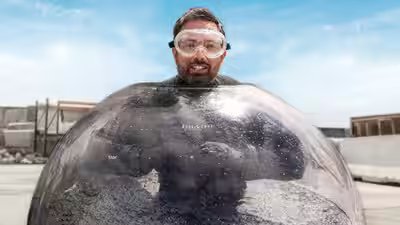
Concrete is the most widely used manufactured material on Earth, yet most people only ever encounter it once it has already hardened into a wall, a road or a slab. Science communicator Derek Muller set out to understand what the material actually does while it is still wet, by climbing into a tank of fresh concrete himself and slowly letting it set around his body. The experiment, conducted with safety precautions and an emergency escape plan in place, revealed something counterintuitive: that concrete is dense enough to make sinking into it far more difficult than climbing back out, a finding that connects directly to why the material behaves the way it does in everything from ancient Roman buildings to modern skyscrapers.
Why concrete is so hard to sink into
Fresh concrete is a mixture of cement, water, sand and gravel, and this combination makes it considerably denser than water, typically weighing around 2,400 kilograms per cubic metre compared to water’s 1,000 kilograms per cubic metre. This density is precisely why a person attempting to submerge themselves in wet concrete finds it so difficult; the material simply does not allow a human body, which is only slightly denser than water, to sink through it easily. The greater physical challenge instead comes from the pressure the material exerts once it begins to stiffen and set around the body, a stage during which movement and breathing can become genuinely restricted.This distinction matters for understanding a persistent myth in construction folklore, the idea that workers have historically been accidentally entombed inside large concrete structures such as dams and bridges. Structural engineers have pointed out that concrete for large-scale projects is deliberately mixed to be as dry and stiff as possible to maximise strength, poured in controlled amounts specifically to prevent this kind of accident, making the scenario far less physically plausible than popular stories suggest.
What gives concrete its strength once it hardens
Once poured, concrete does not simply dry out the way a puddle of water evaporates. Instead, it undergoes a chemical reaction called hydration, in which water reacts with cement to form new crystalline structures that bind the sand and gravel into a solid mass. This process continues for weeks after concrete is initially poured, with the material continuing to gain strength gradually rather than reaching full hardness within hours.Laboratory compression testing, a standard method engineers use to determine how much load a concrete sample can bear before failing, typically involves placing a cured concrete cylinder into a hydraulic press and gradually increasing pressure until the sample suddenly fractures. This sudden, often dramatic failure point is what allows engineers to certify how much weight a particular concrete mix can safely support in a real structure, whether that structure is a residential driveway or a multi-storey parking garage.
Why Roman concrete has survived for thousands of years
Modern concrete structures are generally expected to last several decades, yet numerous Roman concrete structures, including the Pantheon’s dome and sections of ancient Roman harbours, have survived for close to two thousand years. According to astudy published in Science Advances by researchers at MIT and Harvard University, the secret lies partly in small white mineral deposits called lime clasts, long dismissed by researchers as evidence of sloppy mixing by Roman builders.The MIT-led team found instead that these clasts formed through a deliberate technique known as hot mixing, in which the Romans added quicklime directly into the mixture alongside or instead of pre-slaked lime, creating pockets of highly reactive calcium within the finished concrete. According to MIT’s own account of the research, when cracks later form in the concrete, they tend to travel through these lime-rich pockets, and exposure to water triggers a chemical reaction that fills the crack with newly formed calcium carbonate, effectively allowing the material to heal itself over time, a property researchers have confirmed does not exist in most modern concrete formulations.
Why a can of soda can delay concrete from hardening
Among the more unexpected properties of concrete is its sensitivity to sugar. Small amounts of sucrose, the same sugar found in regular soda, can significantly interfere with the hydration process that allows concrete to harden, since sugar molecules bind to the surface of the cement particles and slow down the chemical reactions responsible for setting. This effect is well documented enough that sugar has occasionally been used deliberately as a retarding admixture in construction settings where builders need extra working time before concrete sets, though the effect can vary considerably depending on how much sugar is introduced and at what stage of mixing.
Why concrete production carries such a high environmental cost
Despite its usefulness, concrete comes with a substantial environmental price tag. According to the International Energy Agency, cement production, the key ingredient that binds concrete together, remains one of the most carbon-intensive industrial processes in the world, with total emissions from the sector still higher today than they were in 2015. Most of this comes from a chemical process called calcination, in which limestone is heated to extremely high temperatures to produce clinker, releasing large volumes of carbon dioxide as a direct byproduct of the chemistry itself, separate from the fuel burned to generate the heat.Because concrete is used at such an enormous global scale, this single manufacturing process contributes a meaningful share of humanity’s total industrial emissions each year, making the search for lower-carbon alternatives, including revisiting some of the ancient techniques the Romans once used, an active area of ongoing engineering research rather than simply a historical curiosity.


