








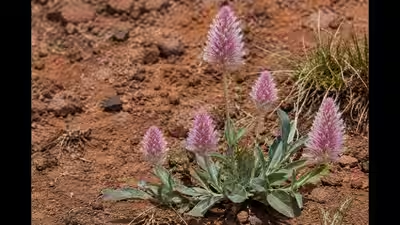
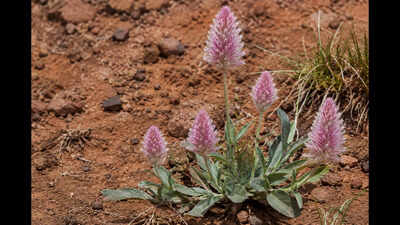
A small Australian shrub that had effectively disappeared from the scientific record for nearly six decades has been found alive in a remote part of northern Queensland. Ptilotus senarius, a species known from only two historical collections, was rediscovered in 2025 after horticulturalist and bird bander Aaron Bean photographed several plants and uploaded the images to iNaturalist. The photographs were then recognised by Queensland Herbarium botanist Anthony R. Bean, who had described the species himself more than a decade earlier. The discovery has now been documented in a 2026 paper in the Australian Journal of Botany by Thomas Mesaglio, Anthony R. Bean and Aaron Bean. Their study describes how citizen science helped locate the presumed-extinct plant and highlights the value of platforms such as iNaturalist in finding species that conventional surveys can miss. The rediscovery is particularly significant because Australia has one of the world’s largest populations of threatened plants, making every surviving population important for conservation.
Meet Ptilotus senarius, the rare Australian shrub scientists had stopped seeing
Ptilotus senarius is a small, slender shrub that can grow to about 60 centimetres tall and produces inflorescences containing between one and six flowers. The species belongs to Ptilotus, a genus of roughly 125 described species, most of which are endemic to Australia. When P. senarius was formally described in 2014, scientists knew it from just two collections made decades earlier in the Gilbert River region of northern Queensland. One had been collected by L. J. Brass in June 1925 from what was recorded as grassy hills, while the second was collected by S. J. Dansie in May 1967 from tea-tree forest. Despite targeted searches between 2008 and 2014, including searches during the same months when the older specimens had been collected, researchers could not find another population. With more than a century of cattle grazing in the region and evidence that some Ptilotus species are sensitive to grazing pressure, the species was eventually treated as presumed extinct.The situation changed before the new discovery was formally made. In the 2024 Census of the Queensland Flora and Fungi, P. senarius was shifted from an extinct-in-the-wild classification to critically endangered, partly because less than half of its potential habitat had been surveyed. That distinction proved important. A species being absent from surveys does not necessarily mean that every remaining individual has disappeared; it can also mean that the population is extremely small, occupies difficult-to-access habitat or survives in an area that has not been thoroughly searched. The authors of the study, published in the Australian Journal of Botany by CSIRO Publishing, place the Queensland discovery within a much broader pattern: more than 400 plant species previously considered extinct have been rediscovered globally during the past three decades.
How one iNaturalist photograph brought the missing plant back into view
The rediscovery began in June 2025 when Aaron Bean encountered an unfamiliar Ptilotus while working in the Gilbert River region. Rather than needing a formal botanical survey to trigger the discovery, he photographed the plants and uploaded the images to iNaturalist, a biodiversity-focused citizen science platform. The photographs showed several plants with buds and flowers. The observation was made within 75 kilometres of the two historical collection sites, on a gentle slope leading towards an ephemeral creek bed with granite-based soils. Around the plants were species including Corymbia grandifolia, Acacia longispicata and Melaleuca citrolens, together with grasses and scattered shrubs. Researchers recorded 15 individual P. senarius plants within an area of roughly 15 metres.The crucial moment came after the photographs were uploaded. Anthony R. Bean, a Queensland Herbarium botanist and the scientist who had described P. senarius, was reviewing recently submitted Ptilotus observations on iNaturalist when he encountered Aaron Bean’s record. He recognised that the photographs could represent the missing species. The discovery was then followed by a specimen collection, which was deposited at the Queensland Herbarium and examined by Anthony Bean. The identification was confirmed as Ptilotus senarius. The researchers deliberately withheld the exact location because the surviving population occurs on private property.The chain of events is what makes the rediscovery particularly unusual. The person who encountered the plants did not initially know that he had found a species thought to be extinct, while the expert who recognised the significance of the photographs happened to be the botanist who had originally described the species. The resulting scientific paper by Mesaglio, Anthony R. Bean and Aaron Bean gives citizen science a central role rather than treating the observation as a secondary source of information. Their study, “Rediscovery of a presumed extinct plant species, Ptilotus senarius (Amaranthaceae)”, was published in volume 74 of the Australian Journal of Botany in 2026 and is available under a Creative Commons Attribution 4.0 licence.
Why a plant can disappear from science without disappearing from Australia
The rediscovery also exposes an important limitation in declaring species extinct. Finding nothing during repeated searches is meaningful, but it is not always definitive. Australia’s vast landscapes, difficult terrain and uneven survey coverage can leave populations undetected for decades. The study notes that 18 of Australia’s 51 presumed-extinct plant taxa had previously been considered “possibly extant” because less than 70% of their potential habitat had been surveyed and relatively few severe threats had been identified. P. senarius illustrates why those gaps matter: the newly confirmed population was found in an area where much of the potential habitat had not yet been surveyed.The species’ history also demonstrates how quickly conservation status can change when new evidence emerges. It had been treated as presumed extinct after searches failed to locate it, but the Queensland flora assessment subsequently classified it as critically endangered rather than extinct in the wild. The distinction is not merely semantic. A critically endangered species can still be protected, surveyed and monitored as a surviving population, whereas an extinct classification can remove it from active conservation priorities. The discovery therefore gives conservation scientists a real population to study and a chance to investigate its habitat, distribution and potential threats.At the same time, the researchers caution against treating rediscovery as proof that a species is safe. The newly found population is small, with only 15 individuals observed in the reported area, and its precise location is being kept confidential. The long period without confirmed observations means there is still much to learn about the species’ distribution and ecology. Its survival also exists within a landscape that has experienced prolonged cattle grazing, one of the factors previously considered relevant to its disappearance from observation.
What the rediscovery reveals about the growing power of citizen science
The most striking lesson from Ptilotus senarius may be that the discovery did not begin in a laboratory or during an official government survey. It began with someone noticing an unusual plant and taking photographs. The researchers argue that iNaturalist can be particularly valuable for rediscovering lost species because it allows observations to come from places that may otherwise be difficult for scientists to access, including private land. Records can also become available rapidly and can be reviewed by a large network of people with specialist knowledge.That does not mean a photograph alone replaces botanical fieldwork. In this case, the iNaturalist observation prompted expert identification and was followed by the collection and examination of a physical specimen. But the platform effectively created the first link in a chain that formal scientific surveys had failed to complete. The researchers therefore suggest that citizen-science platforms could become increasingly useful tools for searching for other plants and animals that have vanished from scientific records.The paper also points to the importance of recording information beyond a photograph. Details such as soil type, surrounding vegetation, habitat conditions and interactions with pollinators can give researchers a much richer picture of where a species survives and what it needs. A photograph can reveal what a plant looks like; contextual information can help explain why it is growing there.The rediscovery of Ptilotus senarius is therefore more than a rare botanical comeback. It is a reminder that some species may survive quietly in landscapes where scientists have not yet found them, and that modern conservation increasingly depends on connecting professional expertise with observations made by people outside traditional research institutions. A single set of photographs, uploaded from a remote corner of Queensland, was enough to bring a plant last collected in 1967 back into scientific view. For a species once presumed extinct, being seen again was the first step towards being studied, protected and given another chance to survive.


