










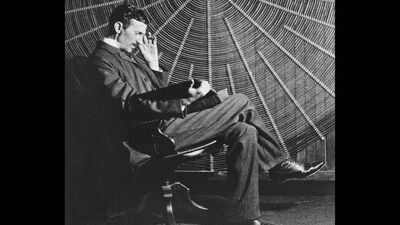
Every generation grows up surrounded by things that would have seemed genuinely impossible only a few decades earlier. A technology that once amazed an entire population can become so ordinary that people stop noticing it exists at all. Nikola Tesla, the inventor and engineer whose work helped shape the electrical age, captured exactly this pattern in his own autobiography. “We crave for new sensations but soon become indifferent to them,” he wrote. “The wonders of yesterday are today common occurrences.” The line comes from My Inventions, Tesla’s own account of his life and work, first serialised in 1919 in the magazine Electrical Experimenter, and it captures something about human nature that has held up remarkably well over the century since he wrote it. This is not a quote that requires much unpacking to feel immediately familiar. Anyone who has ever unwrapped a new phone with genuine excitement, only to be checking it absent-mindedly within a fortnight, already understands exactly the pattern Tesla is describing here, stretched out across an entire civilisation rather than a single gadget.
Quote of the day by Nikola Tesla
“We crave for new sensations but soon become indifferent to them. The wonders of yesterday are today common occurrences”
What is the meaning of Nikola Tesla’s quote
Tesla’s quote is really about how quickly people become accustomed to something new. When an unfamiliar experience or invention first appears, it creates genuine excitement and curiosity, and people want to see it, understand it and try it for themselves. Once they encounter it repeatedly, though, that novelty quietly fades away. An invention that once felt remarkable can eventually become so normal that nobody thinks about how extraordinary it originally was. Tesla names that shift directly, contrasting the “wonders of yesterday” with the “common occurrences” of today.
Why people become accustomed to new things so quickly
Human attention responds strongly to genuine novelty. A new experience stands out precisely because it differs from everything already familiar, and once the mind adjusts to it, that same experience simply requires less attention going forward. This is why a new phone can feel exciting on the day it arrives and completely ordinary within weeks. A new job can feel strange during the first few weeks before settling into routine almost without anyone noticing the shift happening. Tesla recognised this exact tendency well over a century ago, long before phones or modern workplaces existed to illustrate it.
Tesla lived through an age of genuine technological transformation
Tesla’s own lifetime coincided with some of the most significant technological shifts of the modern era. Electric lighting was spreading rapidly, electrical networks were being built from scratch, and entirely new forms of communication were changing how people could interact across real distances. Technologies that look completely basic today would have seemed extraordinary at the time. Tesla understood that shift directly, from the inside, as an inventor and engineer whose own work helped shape the electrical age, while also recognising clearly that people would quickly grow used to even the most genuine breakthroughs.
The “wonders of yesterday” are everywhere around us today
Consider how many things now feel completely ordinary despite once being genuinely extraordinary. Instant communication across continents, moving pictures available on demand, satellite navigation and powerful computers small enough to fit in a pocket would all have seemed astonishing to earlier generations. Today, people use every one of these things without giving much thought to the scientific and engineering effort sitting behind them. Tesla’s observation reaches well beyond his own era. The same basic pattern continues every time a new invention moves from novelty into simple normality.
Why constant novelty rarely produces lasting satisfaction
The quote also says something about the pursuit of new experience generally. People often keep searching for something new because novelty itself creates real excitement, and once that experience becomes familiar, attention naturally drifts toward the next thing instead. The pattern tends to repeat itself, new experience, excitement, familiarity, indifference, then a search for something new again. Tesla’s observation is not really condemning this behaviour. It is simply naming how predictable the whole cycle actually is.
Why people sometimes fail to notice genuine progress
Familiarity has a way of making remarkable achievements almost invisible. Someone might complain about a slow internet connection while rarely stopping to consider that instantaneous global communication would have seemed unimaginable to almost anyone only a few generations earlier. Modern medicine, transport and communication can all look completely ordinary simply because people grew up already surrounded by them. Tesla’s quote is really an invitation to pause for a moment. Something does not actually become less remarkable simply because people have grown used to it.
What this quote suggests about technology specifically
The observation feels especially relevant during a period of genuinely rapid technological change. New technologies can attract enormous attention the moment they first appear, before gradually becoming woven into everyday routine. That process seems to move faster with each generation, since people are now constantly exposed to new devices and services. What looks revolutionary today can quietly become an invisible part of daily life by tomorrow.
Other memorable quotes by Nikola Tesla
- “The present is theirs; the future, for which I really worked, is mine.”
- “Our virtues and our failings are inseparable, like force and matter.”
- “Be alone, that is the secret of invention; be alone, that is when ideas are born.”
- “A new idea must not be judged by its immediate results.”
Why this timeless message still resonates
Tesla’s observation remains striking because the pattern he described has never really disappeared. Every generation encounters technologies that initially feel extraordinary, then gradually learns to use them, folds them into daily routine, and eventually stops noticing how remarkable they once were. That may be one of the genuinely curious features of progress, that the more successfully a breakthrough gets absorbed into everyday life, the less extraordinary it ends up feeling. Tesla’s words are really a reminder to occasionally look at something familiar with fresh eyes. The wonders of yesterday may have become perfectly ordinary, but the history, ingenuity and impact behind them never actually disappeared just because people got used to them.


