









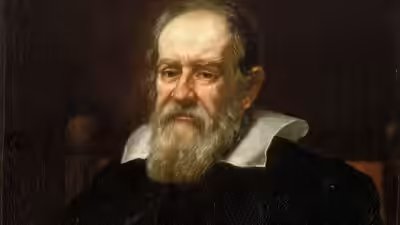
Most of us meet mathematics as a school subject, a pile of sums and rules to survive before the bell rings. Galileo Galilei saw something else entirely. To him, maths was not a chore invented to torment teenagers. It was the secret code the whole universe is written in, the alphabet behind planets, tides, falling stones and everything in between. Learn that language, he believed, and the world stops being a confusing blur and starts to make sense. Refuse to learn it, and you spend your life lost. It is a bold claim from the man often called the father of modern science. It is also, four centuries later, holding up remarkably well.
Quote of the day by Galileo Galilei
“Mathematics is the language in which God has written the universe.”
The real meaning behind one of Galileo’s most famous quotes
Before going further, it is worth being honest about the words. The tidy version we all share is a polished paraphrase. What Galileo actually wrote, in a book called The Assayer in 1623, was a little longer and a little stranger.He described the universe as a grand book that lies open in front of us all the time. But you cannot read it, he said, until you learn the language it is written in. That language is mathematics, and its letters are triangles, circles and other shapes. Without them, he wrote, you simply wander around in a dark labyrinth, understanding nothing.One small detail matters. Galileo’s original line does not actually mention God. That word was added later by people retelling the quote. It fits his world, since he was a believer who saw an orderly cosmos, but the famous phrasing is a touch grander than what he really put on the page. The idea underneath, though, is exactly his.
Why Galileo believed mathematics is the language of the universe
Strip it down and the claim is simple but huge. The universe is not random. It runs on rules, and those rules are written in numbers.Drop a stone and it falls in a precise pattern you can predict with an equation. Planets swing around the sun on paths you can plot. The same few mathematical relationships keep showing up everywhere, in the orbit of a moon and the arc of a thrown ball. Galileo’s point was that these are not coincidences. Maths is not something humans paint on top of nature to feel clever. It is the structure holding nature up. To understand how anything really works, you eventually have to count, measure and calculate.So when he calls maths a language, he means it literally. It is how the universe tells you the truth about itself, if you bother to learn the words.
The part that still gives scientists chills
Here is the genuinely strange bit, and even today nobody has fully explained it.Mathematics often gets worked out by people sitting in quiet rooms, pushing symbols around for the fun of it, with no real world use in mind. And then, years or centuries later, that same abstract maths turns out to describe something real with eerie precision. Curves studied by ancient Greeks for pure interest later mapped the paths of planets. Strange equations dreamed up by mathematicians ended up running the physics behind your phone. One famous physicist called this the unreasonable effectiveness of mathematics, because there is no obvious reason a game played in our heads should fit the outside universe so perfectly.This feeds an old argument that is still alive. Did we invent mathematics, or did we discover it? Is it a human tool that happens to fit reality, or is it the deep wiring of reality itself, sitting there waiting to be found? Galileo clearly leaned toward the second. The universe, in his view, was already mathematical long before anyone showed up to do the sums.
Why it matters far beyond the classroom
It would be easy to file this under nice old quotes and move on. That would be a mistake, because the modern world is basically proof that Galileo was onto something.Almost everything around you runs on his idea. The GPS that guides your car bends time and distance using equations. The weather forecast is maths chewing through mountains of numbers. Medical scans, video calls, online banking, the AI tools spreading through every workplace, all of it is built on mathematics doing exactly what Galileo said it could, reading and predicting the world. We are surrounded by people who never think about maths, living inside a civilisation that could not exist without it.That gap is worth noticing. The more the world runs on numbers, the more power sits with the people who can speak their language, and the easier it is to be quietly left behind if you cannot.
How to take it to heart
You do not need to become a mathematician to live a little more like Galileo. You just need to stop treating maths as the enemy.
- Drop the line “I’m not a maths person.” Galileo’s whole argument is that maths is a language, and almost anyone can pick up a language with steady practice. The belief that you cannot do it is usually the only real barrier.
- Hunt for the maths inside things you already love. Music runs on ratios, sport is full of angles and averages, cooking is really chemistry and proportion. Spotting it makes the subject feel friendly instead of frightening.
- When something puzzles you, ask what numbers are hiding underneath. Why does a loan balloon so fast, why does the moon look huge near the horizon. There is almost always a clean mathematical answer waiting.
- Treat a bit of maths as learning to read reality. Even small fluency, enough to question a statistic or sanity check a number, lets you see through a lot of nonsense the rest of the world swallows whole.
Why numbers are more than symbols in Galileo’s universe
It is a little funny that a sentence about equations can feel almost poetic, but that is the heart of Galileo’s idea. He was not selling maths as dull homework. He was saying that hidden behind the noise and mess of the world there is an order so reliable you can write it down, and that learning to read it is one of the most powerful things a person can do.You can ignore that invitation, as most people do, and still get by. Or you can take Galileo at his word and treat numbers not as a wall but as a door. Behind it, he promised, is the whole grand book of the universe, lying open, waiting for anyone willing to learn the language to read it finally.


