Headlines

Swiss scientists built tiny flying robots without motors or batteries, using sound waves to generate thrust and steer them through the air |

Engineers in Switzerland have worked out how to make miniature robots fly and steer without a single motor, magnet or battery on board. Researchers at the École Polytechnique Fédérale de Lausanne have built hollow structures that turn sound waves directly into thrust, drawing on Helmholtz resonance, the same physics behind the low hum produced by…


Read More

Quote of the day by Neil deGrasse Tyson: “As an educator, it’s my duty to empower you to think. So that you can…” – a powerful message on education |

Quote of the day by Neil deGrasse Tyson (Image: Wikipedia) Neil deGrasse Tyson‘s words present education as something considerably bigger than simply memorising facts. “As an educator, it’s my duty to empower you to think,” he said. “So that you can go forth and think accurate thoughts about how the world is put together.” He…

Read More

Hong Kong scientists found that ultrathin diamond sheets can generate electricity when bent, revealing a hidden piezoelectric effect |

Diamond has long been regarded as a nonpiezoelectric material. Now, researchers have identified a piezoelectric effect in ultrathin, ultraflexible polycrystalline diamond membranes. Piezoelectric materials produce an electrical response when they are mechanically pressed, bent, or stretched. In the study, the researchers found that the effect in diamond membranes varies with their thickness, with the strongest…

Read More

Scientists use robots more than two kilometres beneath the Pacific to discover huge lava fields around an active underwater volcano |

More than two kilometres beneath the surface of the Pacific, off the coast of Oregon, an active underwater volcano has been hiding one of the strangest landscapes ever mapped on the seafloor. Using robotic vehicles capable of withstanding crushing depths, scientists from the Monterey Bay Aquarium Research Institute have spent more than two decades surveying…

Read More

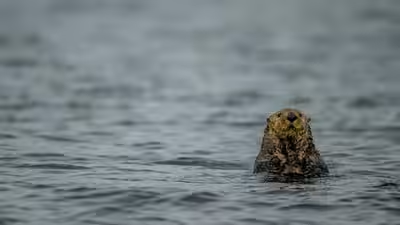
Sea Otters were successfully reintroduced in Canada after their extinction due to fur trade, protecting the kelp populations; but now they are threatening a ‘local delicacy’

The reintroduction and success of sea otters in British Columbia was a story that initially satisfied everyone including conservationists and the natives. The adorable creatures once occupied much of Canada’s Pacific coast, before the fur trade for their exceptionally dense coats turned into a mass death sentence. But now, their population is threatening the availability…

Read More

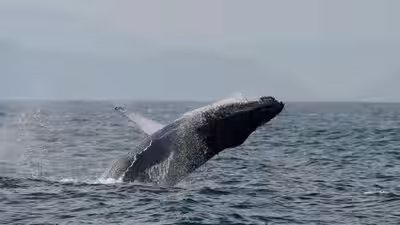
Once hunted to near extinction, Brazil’s humpback whales make a stunning comeback, population surges from just 2,000 to nearly 35,000 in two decades

A humpback whale breaches off the coast of Rio de Janeiro, Brazil. (AP photo) Humpback whales are returning in large numbers to Brazil’s coast after being pushed close to extinction by commercial whaling. Their population in the South Atlantic has risen from about 2,000 to around 35,000 in roughly 40 years, bringing the species close…

Read More

At 14, a Kerala girl turned an everyday bicycle into a low-cost washing machine for Rs 2,000 that could wash clothes without electricity |

At a time when laundry was one more task competing with school, travel and family responsibilities, a Kerala schoolgirl began thinking about a surprisingly simple alternative to the washing machine she did not have. Remya, who was studying in the 10th standard, was already spending hours travelling to school each day and helping her twin…

Read More

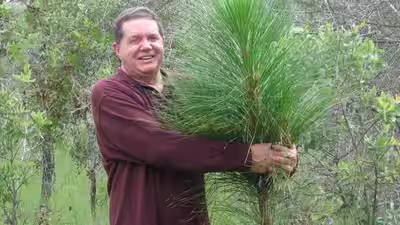
A man bought 51,000 acres of degraded land in Florida; decades later, it became the largest private restoration project east of the Mississippi

He is 85, known as the father of sociobiology, has been at Harvard for 60 years, and has won a hundred scientific awards, including two Pulitzer Prizes. Yet what E.O. Wilson, an evolutionary biologist, is focused on is a new conservation approach, a new ecological Grail which is a quest to refute conservation sceptics who…

Read More

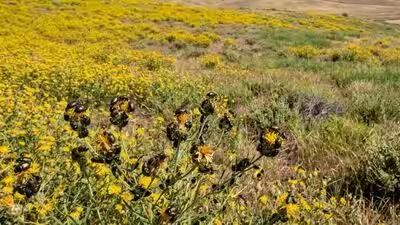
California had 2.34 million acres covered by a toxic yellow weed until tiny Australian beetles fought back and reduced it by 99% within a decade |

For years, St. John’s wort was treated as a useful medicinal plant in parts of Europe. In northern California, its reputation became very different. The yellow-flowered weed spread across pasture and open land, reducing the value of grazing areas and creating another problem for livestock because animals that consumed enough of it could become dangerously…

Read More