




Singapore covered a reservoir with 122,000 floating solar panels; it now powers 5 water-treatment plants and cuts 32,000 tonnes of CO₂ every year |

Singapore has turned part of a reservoir into a giant renewable-energy installation, covering about one-third of Tengeh Reservoir with more than 122,000 floating solar panels spread across 10 floating islands. The 45-hectare Sembcorp Tengeh Floating Solar Farm has a capacity of 60 MWp and generates electricity used to support five local water-treatment plants. The project…

Read More

A 240-million-year-old fossil disappeared for 20 years, then its rediscovery revealed a new reptile related to dinosaurs and crocodiles |

A fossil found in southern Brazil is giving researchers a closer look at the reptiles that lived near the beginning of the archosaur lineage, the group that would eventually include dinosaurs and crocodile-line animals. The animal has been named ‘Silescelida acristata’ and is identified as an early-diverging eucrocopodan archosauriform from the Middle Triassic. A recent…

Read More

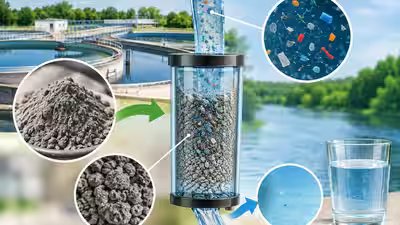
In 2026, researchers turned water-treatment waste into a filter for microplastics; real-water tests removed 86.9% to 97.1% of the particles

Representative Image (AI-generated) Microplastics are now found across aquatic environments, creating a difficult challenge for water-treatment systems that must remove tiny plastic particles without generating more waste. A new approach investigated in 2026 takes an unusual route: instead of treating water-treatment waste as something that simply needs to be discarded, researchers turned it into a…

Read More

Archaeologists were excavating a Roman cemetery in Poland when they found a much older man buried with two decapitated human heads, 42 animal teeth and a battle axe

Ancient Polish burial reveals man with 2 skulls, 42-tooth necklace and battle axe (Image Credit: X/ @sputnik_brasil) Archaeologists investigating a Roman-period cemetery in Poland made an unexpected discovery when they came across a burial that was thousands of years older than the surrounding graves. Instead of a Roman-era burial, they found the nearly complete skeleton…

Read More

Australia brought digging mammals back to an 8,000-hectare sanctuary; 8 years later, scientists found they had reshaped underground insect communities |

Image Credit: Brad Leue/AWC Australia’s effort to bring digging mammals back to an 8,000-hectare wildlife sanctuary has produced changes below the surface. Researchers studying Scotia Sanctuary in south-eastern Australia found that 8 years after reintroduced mammals were given access to areas, the communities of insects emerging from the soil had changed. The mammals, including greater…

Read More

Not just Nepal: How climate change puts European Alps under threat of glacial retreat and rock fall

Tourists look at the Mont-Blanc massif mountains and the ‘Mer de Glace’ glacier at the Montenvers station in Chamonix, France (Photo: AP). Climate change is increasingly becoming a threat to the snow-clad European Alps, amid initial investigations associating the August 26 Nepal tragedy with rising temperatures.Average temperatures in July, on the Aiguille du Midi peak,…

Read More

Nepal’s farmers built terraces into steep Himalayan slopes; now growing macaque populations are making it harder to keep their harvests |

Nepal’s mid-hills are places where farming has long meant working with the landscape rather than against it. Terraces cut into steep slopes turn difficult ground into fields for maize, millet, rice and other crops, with generations of farmers maintaining the walls and soil that make cultivation possible. But the balance between people, farmland and wildlife…

Read More

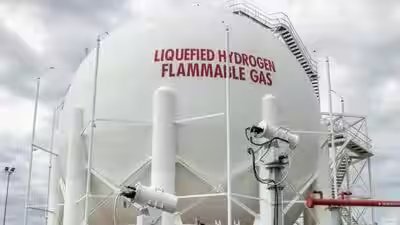
Scientists found an unexpected second product while making cleaner hydrogen; the leftover material was high-quality graphite |

Liquid hydrogen Tank at NASA Kennedy Space Center. Image Credit: US Department of Energy Scientists working on a cleaner way to produce hydrogen have discovered an unexpected second product which is high-quality graphite. The finding emerged from research into methane pyrolysis, a process that splits methane into hydrogen and solid carbon instead of producing CO2…

Read More

In 2014, Mexico began a massive 1 million-hectare restoration drive; 4 years later plant survival had risen from just 33% to 64% |

Restoring damaged land can look straightforward on paper: plant trees, repair soils and wait for vegetation to return. On the ground, the work is less predictable. Young plants have to survive drought, poor soils, fire, grazing and the other pressures that caused landscapes to deteriorate in the first place.Mexico’s National Forestry Commission, known as CONAFOR,…

Read More

In 2024, four Klamath River dams came down, reopening habitat blocked for over a century; in two salmon runs, 21,052 Chinook moved upstream and reclaimed 88% of their historic range

Four concrete barriers blocked the way for salmon that once swam freely between the Pacific Ocean and the high desert reaches of Oregon and California for more than a hundred years. The dams were removed in 2024 as part of one of the largest dam removal projects in U.S. history, letting the river flow freely…

Read More