






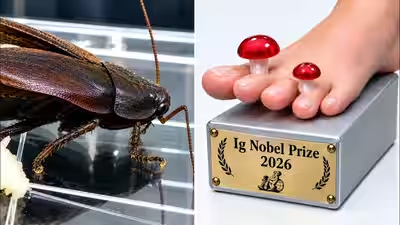
Scientists studied cockroach milk and won an Ig Nobel Prize for it; crystals inside contain a dense store of nutrients |

Image Credit: Left/The Wire/Right/CNN A cockroach producing something resembling milk sounds like an unlikely subject for serious scientific research. Yet one species has developed a remarkably unusual way of nourishing its young. The Pacific beetle cockroach, Diploptera punctata, gives birth to live offspring rather than laying eggs, and its developing young feed on a milk-like…


Read More

Harvard neuroscientists kept human brain organoids alive for over five years, breaking the 694-day record and mimicking brain development |

Harvard neuroscientists have kept tiny clusters of human brain cells alive in laboratory dishes for more than five years, setting a new record that could change how researchers study the human brain. The peppercorn-sized brain organoids, each containing more than one million cells from the cerebral cortex, survived for roughly three times as long as…

Read More

End of the world: Scientists reveal 7 countries most likely to survive a global collapse by maintaining society and food production

With countries fighting wars and natural calamities sweeping away civilisations, it seems a global collapse might be a spark away. But the possibility of entire humanity vanishing off the face of Earth seems a little less plausible with the years of effort we have spent preparing solutions for such situations. However, not everyone can be…

Read More

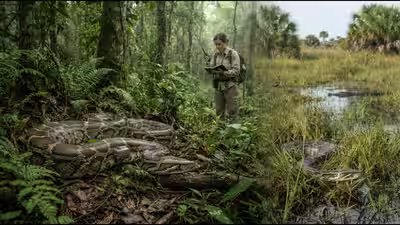
Florida hunts Burmese pythons, but Bangladesh is tracking them to save them; scientists are using radio tags to understand the threatened snake |

The Burmese python has become a symbol of two completely different conservation battles. In Florida, wildlife managers search for and remove the giant snake because its introduced population is threatening native wildlife in the Everglades. Thousands of kilometres away in Bangladesh, researchers are putting radio transmitters on the same species to understand where it moves,…

Read More

In 1921, a 14-year-old Idaho farm boy imagined sending pictures through the air from a potato field, inspiring the invention of electronic television |

PC: Harris & Ewing/Wikipedia In 1921, a 14-year-old boy working in an Idaho potato field imagined something almost impossible: sending pictures through the air in the same way radio carried sound. His name was Philo Farnsworth, and the vision he had would eventually lead him towards electronic television. Farnsworth believed pictures could be transmitted as…

Read More

Scientists turn one of the world’s hardest-to-recycle plastics into high-performance engine lubricant, giving stubborn PVC waste a valuable second life |

One of the world’s most difficult plastics to recycle could soon have a far more valuable second life. Scientists at Virginia Tech have developed a chemical method that converts polyvinyl chloride, or PVC, into polyalphaolefin, an important material used in high-performance lubricants including engine oil. The approach tackles a longstanding problem with PVC, which is…

Read More

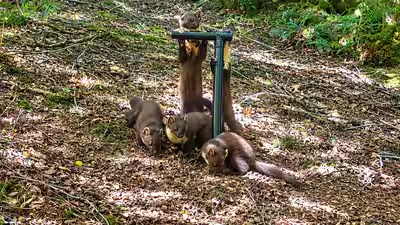
Pine martens vanished from England for a century; locals built den boxes and set up cameras to track their return, now four kits have been spotted |

Pine martens are making a remarkable return to south-west England after disappearing from Exmoor for more than a century, with conservationists capturing the first confirmed evidence that the reintroduced animals are breeding in the wild. A remote trail camera recorded a female pine marten with four kits on Exmoor, signalling that an ambitious effort to…

Read More

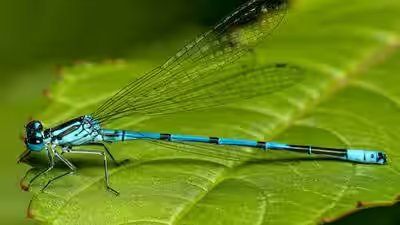
Nearly 70 years after Tucson’s Santa Cruz River ran dry, 2.8 million gallons of reclaimed water began flowing daily; within 4 months, 37 dragonfly and damselfly species were recorded

damselflyRepresenative image from Canva For much of the 20th century, the Santa Cruz River that winds through Tucson, Arizona, existed more as a memory than a living waterway. Groundwater pumping, drought and urban growth drained the riverbed, leaving long stretches of dry sand and scattered pools. Then, in a quiet but transformative experiment, treated wastewater,…

Read More

In 2016, conservationists put the bends back into a Lake District river straightened 200 years earlier; within months, Atlantic salmon were spawning there for the first time in centuries

Centuries after people forced a Cumbrian river into a straight, artificial channel, nature has reclaimed its original course in the Lake District, bringing endangered wild fish back to historic spawning grounds almost immediately. In the summer of 2016, conservationists restored a 1.1-kilometre stretch of Swindale Beck near Haweswater by putting its natural bends back into…

Read More

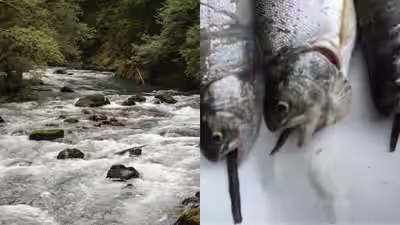
From 1915 to 1972, Mount Rainier stocked more than 9 million fish into naturally fishless waters; today 35 mountain lakes still hold breeding non-native populations that displace amphibians and alter ecosystems

View of the Ohanapecosh River and predated Northwestern Salamanders (Ambrystoma gracile) eaten by introduced trout. Mount Rainier’s glaciers and snowfields feed a magnificent system of icy streams and mountain lakes. On the surface, these waters look pristine, scattered pools in one of America’s most iconic landscapes. But beneath the surface, scientists are looking at a…

Read More