





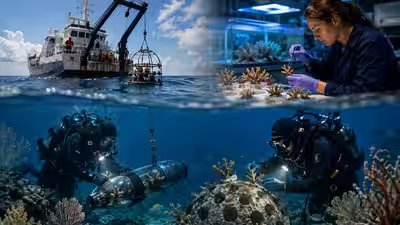
In 2010, Deepwater Horizon damaged deep-sea coral habitats; 16 years later, NOAA divers are planting lab-grown colonies to help rebuild them

Representative Image (AI-generated) Sixteen years after the Deepwater Horizon oil spill injured extensive coral habitats in the Gulf of Mexico, scientists are developing new ways to help these fragile ecosystems recover. According to NOAA Fisheries, a recent restoration mission combined laboratory-reared corals, specialised technical diving and newly designed equipment to return corals to the deep…
Read More

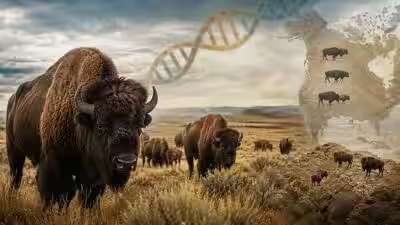
North American bison fell from millions to hundreds, but ancient DNA shows they kept much of their genetic diversity as isolated herds became different

Scientists have pieced together the deepest genetic history of the North American bison ever assembled, using DNA drawn from 115 animals that lived before the species was pushed to near extinction in the 20th century. As per the findings, led by researchers at the University of California, and featured on the cover of the 6…

Read More

Most dreaming happens during REM sleep, which makes up 20–25% of the night; if vivid dreams keep leaving you exhausted, scientists say the real culprit may be something else, keeping you from restorative sleep

Not everyone who closes their eyes and hits the bed at night goes to sleep. Some end up transitioning into a dream-like state that has them waking up while feeling hazy, lazy and heavy, with no feelings of rest and freshness. But is it the dreams that weigh you out or does it have something…

Read More

MIT engineers create a recyclable elastic yarn that can be melted and respun into new fibre 10 times and can tackle the growing problem of textile waste

MIT researchers melt resin pellets and spin them into thin, stretchy fibres designed for repeated recycling. MIT engineers have developed a new elastic yarn made from polyethylene that could offer a more recyclable alternative to conventional stretchy fibres such as spandex. The material is designed so its components can be melted together and processed into…

Read More

Quote of the day by Nikola Tesla: “We crave for new sensations but soon become indifferent to them. The wonders of yesterday are…”

Quote of the day by Nikola Tesla (Image: Wikipedia) Every generation grows up surrounded by things that would have seemed genuinely impossible only a few decades earlier. A technology that once amazed an entire population can become so ordinary that people stop noticing it exists at all. Nikola Tesla, the inventor and engineer whose work…

Read More

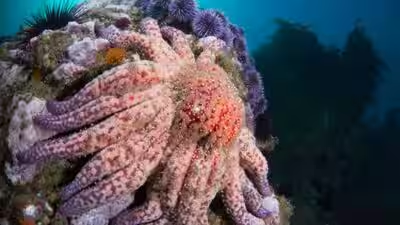
More than 99% of California’s sunflower sea stars vanished, now scientists have found a mysterious colony that could help revive dying kelp forests

A decade ago, more than 99% of sunflower sea stars vanished from the depths of the ocean. Now, the discovery of a long-lost colony of these organisms is offering new hope for the region’s kelp forests.Sunflower sea stars, known as Pycnopodia helianthoides, may look like an aesthetic and purely decorative feature on the ocean floor,…

Read More

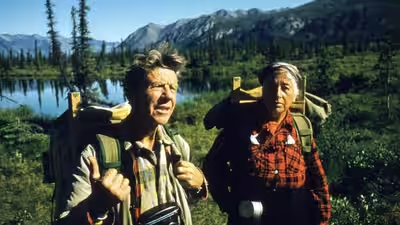
In 1922, Olaus Murie entered Alaska to study caribou, helping change how scientists understood wildlife and ecosystems

In 1922, biologist Olaus J. Murie entered Alaska’s vast wilderness to study caribou, beginning a body of field research that would eventually influence how scientists and park managers understood wildlife as part of interconnected ecosystems. Murie had been hired by the US Biological Survey as a wildlife biologist and spent much of the early 1920s…

Read More

In 2020, engineers pumped 225,000 cubic yards of dredged sediment into the Columbia River; it became four new islands now being studied as salmon habitat

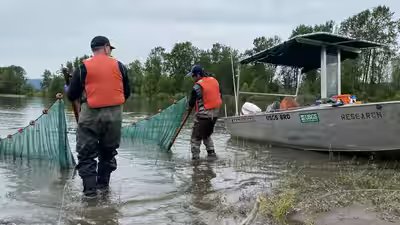
Brian Ekstrom and Lance Downing pulling the beach seine to collect juvenile fish at a restoration site on the lower Columbia River A routine dredging project on the Lower Columbia River has become a major long-term experiment to see whether dredged sediment can be used to restore lost wildlife habitat.In October 2020, engineers pumped 225,000…

Read More