






Headlines

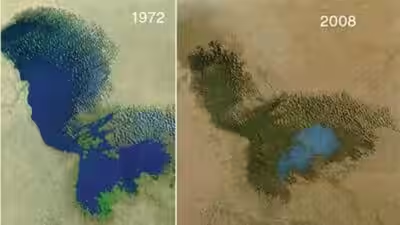
Africa’s Lake Chad has shrunk by 90% since 1960, now the government is paying $50 billion to redirect water from the Congo River Basin into the lake

In 1823, British explorers Hugh Clapperton, Dixon Denham and Walter Oudney were some of the first Europeans to document the lake and the surrounding kingdoms. He was struck at the sight of one of Africa’s largest inland lakes. But two centuries later, about 905 of the lake’s surface area has shrunk, leaving only a sliver…


Read More

In 2008, MSU scientists discovered a tiny fungus hiding inside a rainforest tree that naturally produced diesel-like fuel |

Image(s): Left/MSU/Right/Canva For decades, scientists have searched for cleaner alternatives to fossil fuels, looking everywhere from algae and bacteria to agricultural waste. In 2008, one of the most unexpected discoveries came from deep inside the South American rainforest. Researchers identified a microscopic fungus living quietly within the tissues of a tree that produced a mixture…

Read More

Quote of the day by David Attenborough: “No one will protect what they don’t care about; and no one will care about…” |

Few people have inspired a deeper appreciation for the natural world than David Attenborough, whose documentaries have introduced generations to Earth’s extraordinary wildlife and ecosystems. Among his many memorable observations, one quote continues to resonate with conservationists, educators and nature lovers alike: “No one will protect what they don’t care about; and no one will…

Read More

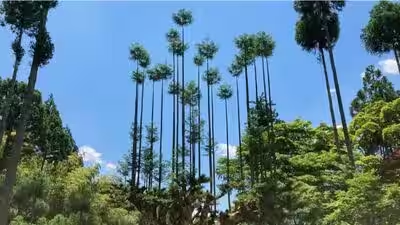
Japan’s 600-year-old Daisugi forestry method lets a single tree produce timber for centuries without being cut down

Japan’s 600-year-old Daisugi technique offers a unique way to produce timber without cutting down entire trees Timber is one of the biggest reasons trees are cut down all over the world. However, in Japan, a country focused on sustainability, an ancient forestry technique called Daisugi harvests timber without cutting the tree.The method began around 14th…

Read More

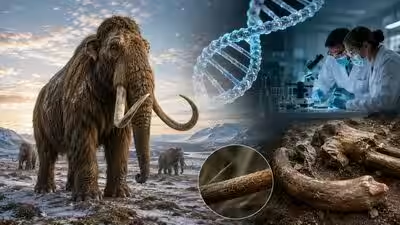
The last woolly mammoths survived for 6,000 years after the Ice Age. In 2024, scientists challenged the idea that inbreeding caused their extinction |

For years, the disappearance of the last woolly mammoths seemed to have a straightforward explanation. A tiny population became isolated, interbred for thousands of years and eventually reached a point where its own genetics made survival impossible. That idea found its way into documentaries, textbooks and scientific discussions alike. A study published in Cell, titled…

Read More

Meet Peter Beck: Rejected by NASA and Boeing, the self-taught engineer who built a $2.9 billion space company without a college degree |

Peter Beck never earned a university degree or landed the aerospace job he hoped would launch his career. Instead, the New Zealand engineer turned rejection into an opportunity that reshaped his future. After an unsuccessful trip to the United States in 2006, where attempts to gain experience with organisations including NASA and Boeing fell short,…

Read More

Millions of birds follow a 9,000-kilometre invisible highway every year, crossing mountains, deserts and oceans without a map |

Every year, as the seasons change, millions of birds undertake one of nature’s greatest journeys. Some travel only a few hundred kilometres, while others fly thousands without recognising political borders or national boundaries. Instead, they follow ancient migration routes known as flyways, natural aerial corridors shaped by geography, climate and the availability of food and…

Read More

High-speed fireball meteor with thunderous flashes and sonic boom passed over New Zealand sky, researchers say it could offer a rare glimpse into the solar system’s origin |

Image Credit: Fireballs Aotearoa A spectacular fireball passed over the night sky of New Zealand’s North Island with extreme speed, at approximately 10.26 pm on Tuesday, 28 July 2026. It was accompanied by thunderous rumbles and sharp sonic booms that shook windows and alarmed the livestock in the region. From Auckland down to the Wairarapa,…

Read More

750 Indian schoolgirls conducted experiments within their schools and failed. Now their reworked satellite orbits the Earth near the ISS |

The experiments prepared by 750 schoolgirls from India failed on their first try in 2022. But later, it transformed into a space education activity that has a satellite made by them orbiting the planet near the ISS. The information was released by ISRO, the Indian government’s space agency.Under the AzaadiSAT project, 75 schools across the…

Read More