









Scientists found a mysterious mark inside a 236-million-year-old fossil in Argentina that may reveal ancient mammal relatives gave birth instead of laying eggs
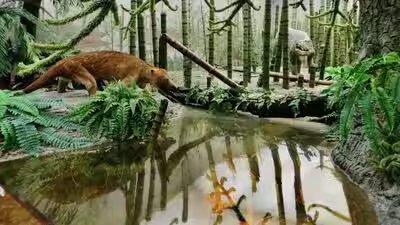
Reconstructed Triassic landscape at the Museum am Löwentor, Stuttgart (Germany), with Chiniquodon theotonicus (left), Batrachotomus kupferzellensis (right), and, poorly visible in the foreground below the water table, a large temnospondyl. Image Credit: Ghedoghedo/Wikipedia A 236-million-year-old fossil from Argentina may have provided the earliest evidence yet that an animal on the evolutionary lineage leading to mammals…