







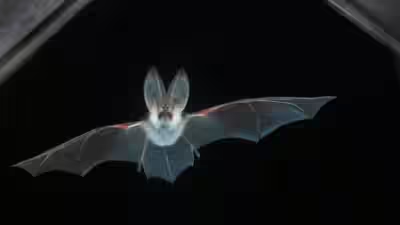
Researchers tracked bats across 49 sheep-grazed pastures in Austria; 20 of the country’s 24 bat species were detected, with some small insect-eating bats more active during and after grazing |

Sheep grazing can change the conditions that bats encounter when hunting for insects, with some species becoming more active while livestock are on the land and for a short time after they leave. A survey of 49 sheep-grazed pastures in southern Burgenland, Austria, recorded 20 of the region’s 24 bat species during the summer of…

Read Full News

A 113-million-year-old baby dinosaur found in South Korea has been named after cartoon character Dooly, revealing the country’s first dinosaur skull remains |

A rare dinosaur fossil found in South Korea has been identified as a new species, the country’s first new dinosaur species in 15 years. The skeleton was found on the Aphae Islands off the country’s southwestern coast and dates to around 113 million years ago. Researchers named it Doolysaurus huhmin after Dooly, a South Korean…

Read Full News

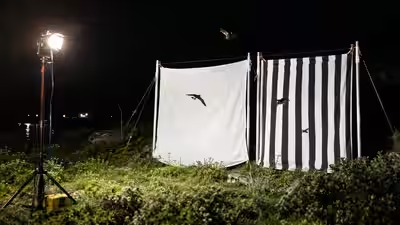
In 2024, researchers began hanging different coloured and patterned sheets inside a Canadian seabird colony; by 2026, their study found stripes caused 2.8 times fewer bird collisions than plain sheets

The study found that darker and patterned surfaces could reduce seabird collisions at night (AI image). Researchers in Canada have found that changing the colour or pattern of a surface could help prevent seabirds from crashing into illuminated structures at night. In experiments conducted during 2024 and 2025 on Bon Portage Island in Nova Scotia,…

Read Full News

A Florida schoolgirl who saw her local waterways deteriorating began collecting discarded oyster shells; her project has amassed 1,600 pounds of shells and drawn more than 60 students and teachers

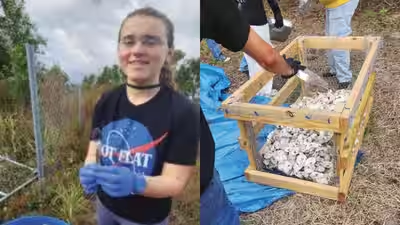
Students earn Marine Sciences honour credits while gaining hands-on experience in oyster restoration and environmental conservation. Some children are born observant and intelligent. They are active with the happenings around them and always look for solution. Meet Bianca Bernhard, whose concern about deteriorating water quality led her to create the Martin Oyster Restoration Initiative, or…

Read Full News

German scientists tested reducing grassland mowing at 45 sites; insect and other invertebrate numbers increased 99% after three years |

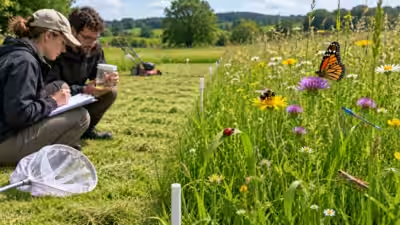
German researchers have tested what happens to grassland invertebrates when land use is reduced. The team worked at 45 sites across three regions of Germany, where plots were mown only once a year, late in the growing season, with no fertilisation or grazing. Invertebrate abundance rose by 41% after one year and by 99% after…

Read Full News

Meet Ramya Manjunath Anche, the Bengaluru-born astronomer leading NASA’s $20 million PUFFINS telescope mission to study tiny dust particles between stars

This is the story of Ramya Manjunath Anche, a Bengaluru-born astronomer preparing to study something that has remained difficult for scientists to understand for decades. The subject is of the tiny particles of dust floating between stars. As a teenager fascinated by the 2003 Space Shuttle Columbia disaster, she has now grown up to lead…

Read Full News

Scientists tested an underwater sound system to keep grey seals away from swimmers at a German beach; seals were 3.57 times more likely to stay farther from the swimming zone |

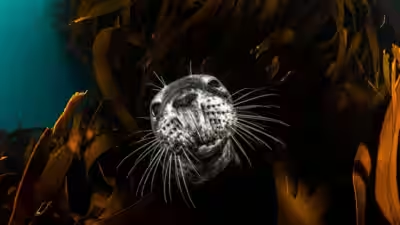
Grey seals at a popular German beach were more likely to stay farther from designated swimming areas when exposed to underwater sound signals, according to a study testing a new way to reduce encounters between marine wildlife and people. Researchers trialled an acoustic deterrent at Helgoland Dune, home to Germany’s largest grey seal colony, to…

Read Full News

Every autumn, residents of Portugal’s tiny Corvo Island switch off public lights for five nights to help young seabirds find the ocean; the wider Azores rescue campaign has saved more than 30,000 fledglings since 2015

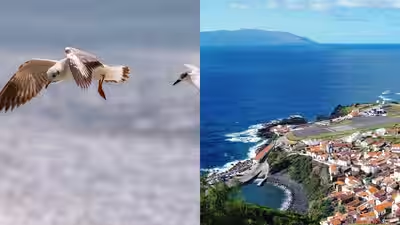
Residents patrol Corvo’s darkened streets, rescuing stranded shearwaters and releasing them safely towards the Atlantic Ocean. Imagine an entire island voluntarily turning off its lights, allowing the night sky to guide thousands of young birds towards the ocean. On Corvo, the smallest and northernmost island of Portugal’s Azores archipelago, darkness is not a sign of…

Read Full News

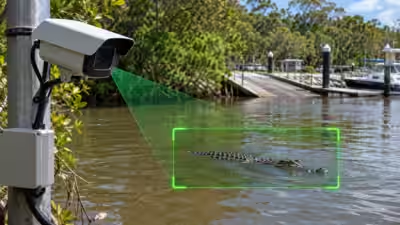
Queensland tests AI cameras trained on 800 hours of footage to detect crocodiles swimming in murky waterways, with the technology being assessed for real-time monitoring near boat ramps and marinas |

Queensland is testing a camera system that uses artificial intelligence to identify crocodiles. In a media release on 24 March 2026, the Department of the Environment, Tourism, Science and Innovation (DETSI) said the project had been given the green light to proceed with its first deployment in northern Queensland. DETSI is working with James Cook…

Read Full News

A woman buried in a French cave around 30,000 years ago carried DNA linked to people in eastern Europe; new analysis of ancient remains challenges the idea that Ice Age populations remained genetically isolated

The woman’s remains were discovered in Isturitz Cave in southwestern France Scientists studying ancient human remains from a cave in southwestern France have found evidence that people living in eastern and western Europe were genetically connected more than 30,000 years ago.DNA recovered from a woman who lived during the Gravettian period showed that although most…

Read Full News