



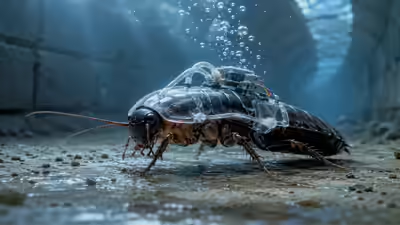
Scientists created remote-controlled cockroaches, then fitted them with tiny suits that kept them walking underwater for up to 3 hours |

Cockroaches are already famous for surviving some of Earth’s harshest conditions, but scientists have now pushed their abilities even further. Researchers have developed remote-controlled cockroaches capable of walking underwater for up to three hours by fitting them with miniature oxygen-supplying suits. The unusual technology could one day help emergency teams search flooded buildings, inspect dangerous…
Read More

Israel planted millions of pine trees but what happened next surprised scientists |

During the mid-20th century, large areas of Israel were transformed by one of the country’s most ambitious reforestation programmes. Millions of pine trees were planted to stabilise soils, combat erosion and create forests on previously open landscapes. At first, the initiative appeared to be an environmental success, with barren hillsides becoming green woodlands. However, decades…

Read More

First underwater home for scientists installed 17 metres below the Florida Keys to support marine research |

DEEP has completed the installation of Vanguard, its pilot subsea human habitat, at Tennessee Reef in the Florida Keys National Marine Sanctuary. The system now sits 17 metres below the water’s surface following a complex marine operation, marking a significant milestone in subsea engineering and long-duration underwater research capability.The installation enables multi-day subsea missions, allowing…

Read More

Why does water taste different in different places: The surprising science behind every sip |

Almost everyone has noticed it. The water at home tastes perfectly normal, yet the moment you travel to another town or country, every sip feels noticeably different. Some water seems sweet and refreshing, while others taste metallic, salty, earthy or even slightly like chlorine. This isn’t simply imagination. The flavour of drinking water is influenced…

Read More

After the Great Wall of China, Africa is building an 8,000-km ‘Wall of Trees’ to fight climate change, restore land and feed millions |

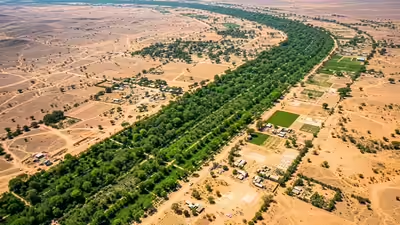
Stretching from the Atlantic coast of Senegal to the shores of Djibouti on the Red Sea, Africa is undertaking one of the most ambitious environmental projects ever attempted. Known as the Great Green Wall, the initiative spans around 8,000 kilometres across the Sahel, a vast semi-arid region bordering the Sahara Desert. Its goal is far…

Read More

Scientists found ancient teeth smaller than a fingertip; they are rewriting early primate history |

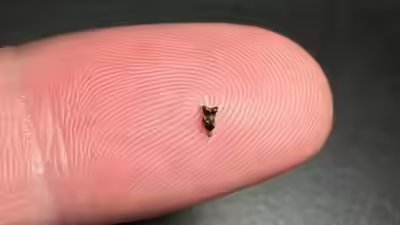
pc: Discover Magazine (Image Credit: Dr Stephen Chester) A tiny tooth can disappear between your fingertips without much effort. Yet some of the earliest clues to our own evolutionary story come from fossils no larger than that. In collections of ancient mammal remains from western North America, palaeontologists have spent decades piecing together fragments of…

Read More

In the 1920s, a Yale-trained forester shot a wolf in the Arizona desert: What he saw next changed conservation forever |

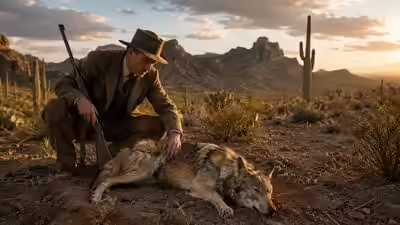
In the early years of the 20th century, conservation in the United States was still taking shape as a profession rather than a philosophy. Forests were being mapped, species counted, land divided into managed zones with a confidence that nature could be organised if only enough data were gathered. Among the young men entering that…

Read More

IISc study finds ultrasound can selectively destroy oral cancer cells

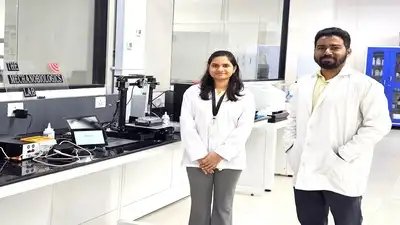
IISc Researchers Rashmita Luha (left) and Ajay Tijore (right) | Credit: IISc BENGALURU: Researchers at the Indian Institute of Science (IISc) have found that low-frequency ultrasound can selectively kill oral cancer cells while leaving healthy cells largely unharmed, raising the possibility of a less invasive treatment for one of India’s most common cancers.Oral cancer remains…

Read More