Headlines

Santanu

Max: Quote of the day by Max Planck: “Science cannot solve the ultimate mystery of nature. And that is because…” |

Few scientists have reshaped humanity’s understanding of the universe as profoundly as Max Planck. Celebrated as the father of quantum theory, the German physicist not only revolutionised modern physics but also left behind timeless reflections on science, philosophy and the limits of human knowledge. One of his most quoted observations is: “Science cannot solve the…

Read More

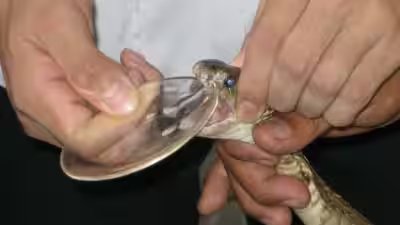
For more than 125 years, horses have quietly helped save snakebite victims. Here’s how their blood becomes life-saving antivenom |

Milking a snake for the production of antivenom. Image Credit: Barry Rogge/Wikipedia Snakebite envenomation(condition where toxic venom is injected into a body via the bite, sting, or puncture of a venomous animal such as a snake, spider, scorpion, or insect), remains a global health issue, causing up to 100,000 deaths per year and affecting millions…

Read More

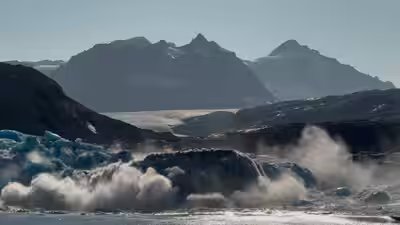
Scientists aboard RRS Sir David Attenborough watched a 1km-wide, 100m-thick section of Greenland’s Sorgenfri glacier break away, weighing an estimated 18 million tonnes

A scientist on board captured the moment the glacier crashed into the ocean. Credit: Alice Fremand Scientists aboard Britain’s flagship polar research vessel, RRS Sir David Attenborough, watched an estimated 18 million metric tonnes of ice crash into the ocean when a massive section of Greenland’s Sorgenfri glacier broke away in a single evening event.The…

Read More

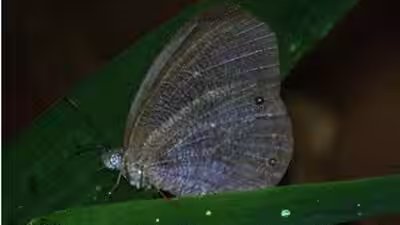
Butterflies are changing where they live across the planet, with climate and extreme weather driving most documented shifts

In Brazil, the blue butterfly Godartiana byses has expanded from the states of Rio de Janeiro and Bahia to Sao Paulo. Butterflies are relocating across the world as climate change and extreme weather continue to alter their habitats. According to a new global study, many species are expanding into new areas, while others are disappearing…

Read More

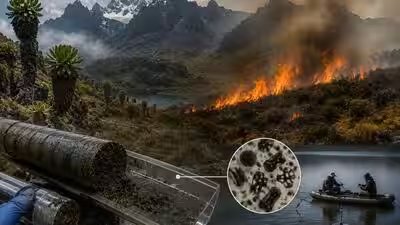
In 2012, a wildfire scorched 42 sq km of the Rwenzori alpine zone; lake cores showed it was the first large-scale fire there in 12,000 years, with charcoal jumping over 100-fold

Representative Image (AI-generated) A wildfire that swept through the high-altitude alpine zone of Africa’s Rwenzori Mountains in 2012 has been identified as the first large-scale fire to strike the region in at least 12,000 years, according to a study published in Nature. By analysing ancient lake sediment cores (cylindrical samples of layered mud from the…

Read More

Meet Arya Satheesh: High school student invents plant-based plastic that removes microplastics as it naturally breaks down, named European winner of The Earth Prize |

Eighteen-year-old Arya Satheesh, a high school student from Letterkenny in County Donegal, Ireland, has earned international recognition for inventing Eco Purge, a plant-based biodegradable plastic. The material is designed to help tackle the growing problem of microplastic pollution. As it naturally breaks down, Eco Purge releases specialised enzymes that are designed to help degrade nearby…

Read More

Scientists studied animal bones in South Australia’s underwater caves; those near light carried algae marks while bones in total darkness remained remarkably pristine

Representative Image (AI-generated) Animal bones resting on the floors of South Australia’s underwater caves are revealing far more than the identity of the creatures they once belonged to. According to a new study published in PLOS One, the cave environment itself leaves distinct “fingerprints” on bones, helping scientists reconstruct how they were deposited, the environmental…

Read More

Moon: Scientists develop a new way to detect hidden water ice on the Moon using seismic waves |

Representative Image of astronauts investigating potential water ice reserves on the Moon (AI-generated image) Beneath the permanently shadowed craters near the Moon’s south pole, scientists believe significant deposits of water ice may be buried out of reach of the instruments currently used to search for it from orbit. A new study led by researchers at…

Read More

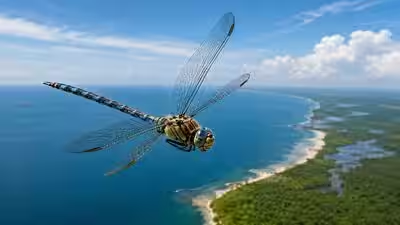
In 2016, Biologists at Rutgers University discovered that the globe skimmer dragonfly is the world’s longest-distance flying insect

In March 2016, researchers identified the globe skimmer dragonfly, Pantala flavescens, as the world’s longest-distance flying insect. Led by researchers at Rutgers University-Newark, the study used genetic analysis rather than direct observation to reach its conclusion, comparing DNA samples collected from dragonfly populations scattered across multiple continents. Rutgers University-Newark findings suggested these insects were travelling…

Read More