








Santanu

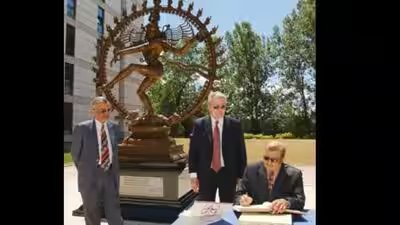
CERN, where scientists smash particles at nearly the speed of light, has a 2-metre Shiva Nataraja statue outside; why India gifted the cosmic dancer to the physics lab in 2004

Lord Shiva Statue Unveiled (CERN official) For those who don’t know, CERN is Conseil Européen pour la Recherche Nucléaire (European Council for Nuclear Research). It is the world’s largest particle physics laboratory near Geneva, Switzerland (near Franco-Swiss border). It is the lab where scientists accelerate particles to almost the speed of light. But beyond this…

Read Full News

Scientists create a brain-to-brain network that lets people communicate without words, offering a breakthrough for human communication |

Brain-to-Brain communication between humans. Image Credit: PASIEKA/Science Photo Library/Corbis Scientists have demonstrated direct brain-to-brain communication using a system that transmitted information between people without speech, typing or physical gestures. The research led to ‘BrainNet,’ a system that connected three people and allowed them to collaborate on a task using brain signals. Electrical activity was recorded…

Read Full News

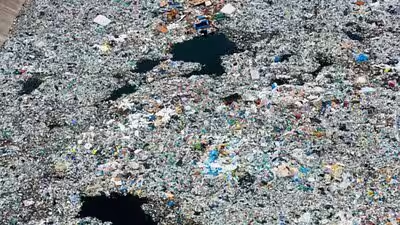
A rotating ‘garbage island’ spreads over 1.6 million sq km in the Pacific: Plastic averages 50 kilograms per square kilometre, and 75 to 86% of the debris comes from fishing gear

A floating and rotating ‘garbage island’ of an estimated area of 1.6 million square kilometres lies between Hawaii and California, according to a scientific estimate published in 2018. The area of the island is said to be larger than Para and nearly three times the size of metropolitan France. What exists here is a plastic…

Read Full News

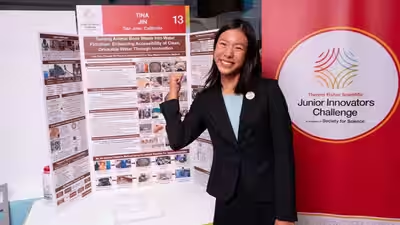
Meet Tina Jin, the 15-year-old Massachusetts student who turned animal bones into a new material for cleaning polluted water |

A 15-year-old Massachusetts student is exploring an unusual way to make polluted water cleaner: using discarded animal bones. Tina Jin, a student at Phillips Academy in Andover, developed a filtration system that uses ground cow, lamb or pig bones arranged in multiple layers to target different contaminants in water. Her research focuses on places where…

Read Full News

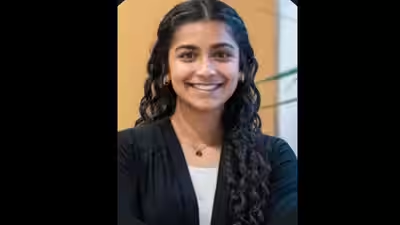
Meet Zainab Nathani, the Illinois student who designed a material that can pull water from humid air using sunlight |

Zainab Nathani, a high school junior from Niles, Illinois, has designed a material that can pull drinkable water straight out of humid air, powered entirely by sunlight. Studying at Niles Township West High School, she built her project around emulsion-templated composite biogels, porous, bio-based structures engineered to trap moisture from the atmosphere and release it…

Read Full News

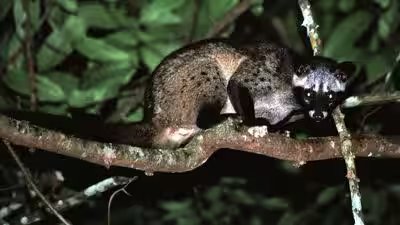
Coffee beans found in Civet poop used to make one of the world’s most expensive Kopi Luwak coffee which costs thousands of dollars per kilogram |

Asian palm civet. Image Credit: Bernard DUPONT/Wikipedia Kopi luwak is one of the world’s most unusual coffees because its production begins inside the digestive system of an animal. The coffee is made from beans eaten and later excreted by the ‘Asian palm civet,’ a small mammal found across parts of South and Southeast Asia. The…

Read Full News

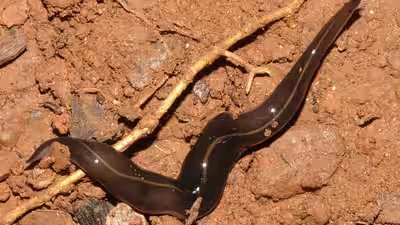
In the 1990s, a predatory flatworm was released in Samoa to control giant African snails; it later became linked to the decline and extinction of native island snails

In the 1990s, a predatory flatworm was released in Samoa to control giant African snails An aggressive predatory flatworm introduced to Pacific islands during the 1990s to control agricultural pests has pushed native land snail species toward extinction, turning a planned biological control program into an ecological disaster. The New Guinea flatworm (Platydemus manokwari) was…

Read Full News

Meet Finnegan McGill, the 18-year-old Arizona student who spent four years building an AI device that can identify birds from their calls and pinpoint where they are |

Finnegan McGill. Image Credit: Chris Ayers/Society for Science Finnegan McGill has spent more than four years turning a concern about declining bird populations into a working piece of technology. This 18-year-old student from Tucson, Arizona, developed a device known as ‘A-BiRD’ (Automated Bird Recognition Device) which could help in identifying birds by their calls and…

Read Full News