






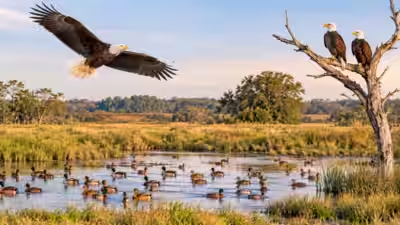
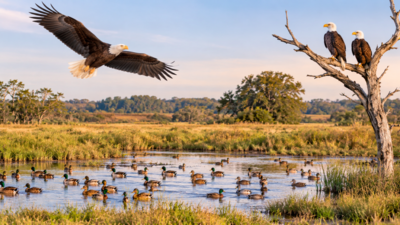
On a stretch of the Texas Gulf Coast where cattle once dominated the landscape and former rice fields offered limited habitat for waterfowl, a ranch has gradually taken a different approach to managing its land. At Lavaca Rio Ranch in Jackson County, wetlands now sit alongside grazing pastures, attracting migratory ducks, nesting birds and other wildlife. The changes have taken years, with ranch staff working alongside conservation specialists to reshape parts of the property and manage water levels throughout the seasons. The results are visible in the number of birds using the land, including three pairs of bald eagles that nested there in 2025.
Lavaca Rio Ranch transforms 5,500 acres into a thriving wildlife habitat
Lavaca Rio Ranch covers approximately 5,500 acres in Jackson County, Texas. Cattle ranching and rice cultivation were once the main uses of the property. Although duck hunting took place there, the fields did not attract waterfowl in the numbers the ranch manager, Brent Friedrichs, would have liked to see.The property still supports a cattle operation, with as many as 300 cows and their calves grazing across the land. But its management has expanded beyond livestock. Prescribed burns, food plots for game birds, controlled grazing and the creation of wetlands have helped establish a range of habitats across the ranch.The changes have brought different species into the area. Ducks are among the most visible visitors, sometimes arriving in their thousands. Turkeys have also been seen nesting near the wetlands, while deer and their young regularly appear around the property.
How the Texas Prairie Wetlands Project is restoring 100,000 acres of habitat
The work at Lavaca Rio Ranch is part of a wider effort to recover wetland habitats along the Texas Gulf Coast prairie. The landscape once contained extensive shallow-water wetlands, including natural depressions known as prairie potholes. Over time, much of this terrain was levelled or converted into agricultural land, particularly for rice production. Wetlands that once covered as much as 30% of the Texas coastal prairie have consequently become far less common. Their loss has affected the habitats available to waterfowl and other wildlife that depend on shallow water, wetland vegetation and seasonal feeding grounds.The Texas Prairie Wetlands Project was established in 1991 to address some of these losses. It brought together Ducks Unlimited, Texas Parks and Wildlife, the US Fish and Wildlife Service and the US Department of Agriculture’s Natural Resources Conservation Service. Its work centres on restoring existing wetlands and constructing new ones, particularly in areas used by waterfowl during winter. The aim is to provide birds with feeding and resting habitat before their spring migration, helping them maintain their condition for the journey.According to Chad Stinson, a biologist with the US Fish and Wildlife Service’s Partners for Fish and Wildlife Program, the initiative has restored or created approximately 100,000 acres of wetlands over three decades. These habitats also contribute an estimated 12 to 16% of the fresh water along the Texas coast in a given year.
Inside the wetland restoration work at Lavaca Rio Ranch
The Partners for Fish and Wildlife Program has worked with Lavaca Rio Ranch for nearly 10 years, offering financial support and technical guidance for habitat improvements. Much of this assistance has gone towards designing and constructing permanent levees and water-control structures. Ranch employees have taken responsibility for carrying out the construction and maintaining the wetland areas. Their work includes adjusting water levels at different points in the year, rather than leaving the wetlands to depend entirely on rainfall.The property’s agricultural history has proved useful in this respect. Its existing well infrastructure allows Friedrichs to introduce water into different sections and control how deeply they are flooded. This gives the ranch greater flexibility when conditions change or when birds begin using a particular area.Water can be directed towards one wetland while another is left undisturbed or allowed to develop fresh vegetation. Later in the season, the ranch can flood the different units more extensively. These adjustments also help provide suitable conditions for resident birds, including mottled ducks and whistling ducks, which benefit from seasonal changes in water depth.
Bald eagles and other species have found a home there
Ducks were the main focus of the restoration work, but the wetlands have attracted a much wider range of wildlife. The ranch has recorded roseate spoonbills, greater yellowlegs, plovers, mottled ducks and wood ducks, alongside other resident and migratory birds. Three pairs of bald eagles also nested on the property in 2025. Stinson described the concentration as unusually high and attributed the presence of the birds to the availability of water and the habitat it supports.The conservation programme specifically targets around 16 duck species. However, Stinson estimates that another 40 to 50 species, including birds, amphibians and reptiles, use the wetland habitats. Wetlands support a variety of feeding and breeding opportunities, making them useful to wildlife beyond the species for which a restoration project was originally designed. Shallow water and wetland vegetation can provide shelter and food for animals at different stages of their lives.
Restored Texas wetlands offer grazing grounds for cattle during dry periods
The restoration has also had practical implications for the ranch’s cattle operation. As water levels fall gradually, the exposed areas can produce vegetation that provides useful grazing, particularly during dry periods. Stinson said other ranchers involved in wetland projects had reported similar benefits for their livestock. Land that supports waterfowl during wetter months can therefore serve another purpose as conditions change.For properties that combine agriculture with conservation, this offers an additional reason to maintain wetland areas. The land does not have to be devoted entirely to either wildlife or livestock, provided water levels and grazing are managed carefully.