








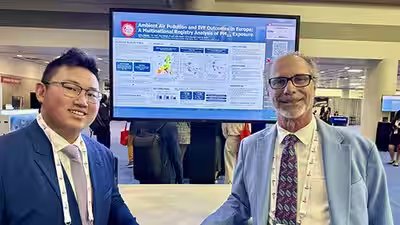
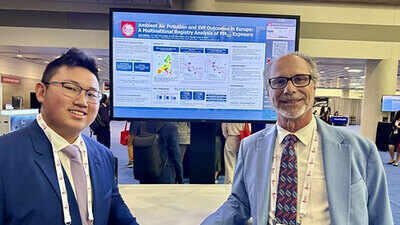
At an age when most students are still exploring their academic interests, this high school student has already presented a medical research study before an international audience. Working under the mentorship of a Stanford professor, he examined whether the air people breathe could have a connection with IVF outcomes.For most Grade 11 students, research in medicine and biomedical science may seem like something reserved for university laboratories. But one high school student has already had the opportunity to take his research beyond the classroom and present it at an international medical conference.Jeffrey Zi Kang Huang, a Grade 11 student at Taipei American School, presented his research at the 2026 American Society for Reproductive Medicine (ASRM) Scientific Congress & Expo in Baltimore, Maryland. His study explored a question that brings together two important areas of human health: environmental pollution and fertility treatment.What makes the achievement particularly interesting is that Jeffrey was not simply attending the conference as a student observer. He was the first author and presenter of a multinational research study, working under the mentorship of Dr Barry Behr, Professor Emeritus of Obstetrics and Gynecology at Stanford University School of Medicine and Interim Director of Stanford’s IVF Laboratory.
What did the high school student’s research find?
Titled ‘Ambient Air Pollution and IVF Outcomes in Europe: A Multinational Registry Analysis of PM2.5 Exposure’, the study examined whether exposure to fine particulate matter in the air could be associated with the outcomes of in vitro fertilisation (IVF).For the research, the team analysed reproductive treatment data from 27 European countries, using information from the European Society of Human Reproduction and Embryology (ESHRE) and air pollution estimates from the World Bank.The analysis identified a trend towards lower IVF clinical pregnancy and delivery rates in countries with higher exposure to PM2.5, a type of fine particulate air pollution that can penetrate deep into the respiratory system.For every 5 micrograms per cubic metre increase in PM2.5 exposure, the researchers observed a 2.39 percentage-point decrease in delivery rates and a 1.91 percentage-point decrease in clinical pregnancy rates.However, the findings were not statistically conclusive. The study also analysed country-level data, which means it cannot establish that air pollution directly causes lower IVF success rates. The results point to a possible association that requires further investigation.The research raises an important question: Could environmental conditions be another factor worth examining when studying reproductive health and fertility treatment outcomes?
How a Stanford professor became part of his research journey
Behind Jeffrey’s conference presentation was the guidance of Dr Barry Behr, an internationally recognised expert in reproductive biology and clinical embryology.With more than 300 scientific publications and conference abstracts to his credit, Dr Behr has contributed to research and developments in embryo culture techniques, blastocyst development and assisted reproductive technologies.For Jeffrey, working with an experienced researcher offered an opportunity to understand how medical research takes shape beyond textbooks and classroom discussions.His involvement included learning about research methodology, statistical analysis, scientific writing and the interpretation of clinical data. He also gained experience in presenting scientific findings to an audience of researchers and medical professionals.Speaking about the experience, Jeffrey said he had always been interested in understanding how science could help address real-world problems. He wanted to explore whether environmental factors, particularly the air people breathe, might be associated with fertility treatment outcomes.He also described presenting at ASRM and learning from leading scientists as an incredible experience, expressing gratitude to Dr Behr for his guidance and encouragement.Dr Behr, meanwhile, said Jeffrey had demonstrated intellectual curiosity, dedication and a willingness to engage with complex scientific questions. He also highlighted the importance of giving motivated students opportunities to participate in meaningful research.
From a school internship to an international research platform
Jeffrey’s association with reproductive medicine research began in August 2025, when he joined Taiwan IVF Group and Ton-Yen General Hospital as a research intern.While continuing his school education, he worked with an international research team under Dr Behr’s mentorship. The experience gave him an opportunity to explore the relationship between scientific concepts and practical medical questions.His work has also extended beyond conference presentations. On October 12, 2026, Jeffrey authored an article titled ‘The Impact of Air Pollution on Fertility Treatment Outcomes’, published in BioNews, a publication of the UK’s Progress Educational Trust.Presenting at ASRM 2026 gave him the opportunity to interact with reproductive medicine specialists, clinical embryologists and researchers from different parts of the world.For a student who hopes to pursue medicine and biomedical science, such exposure can offer a valuable understanding of how research is conducted, questioned and discussed within the scientific community.
Why early research opportunities matter for students
Jeffrey’s experience also highlights how scientific learning can begin well before university. While classroom education introduces students to scientific principles, participating in research can help them understand how those principles are applied to questions that affect everyday life.It also exposes students to the less visible aspects of scientific work, including analysing data, interpreting results, recognising limitations and communicating findings responsibly.His study does not offer a definitive answer about the impact of air pollution on IVF outcomes. However, the process of investigating the question, analysing available evidence and presenting the findings at an international conference marks an important step in his development as a young researcher.As Jeffrey continues his education, he hopes to build on this experience and pursue a future in medicine and biomedical research.His journey offers an interesting example for school students who are curious about science: research does not necessarily have to wait until college. With the right guidance, a willingness to learn and an interesting question to investigate, the journey can begin much earlier.