









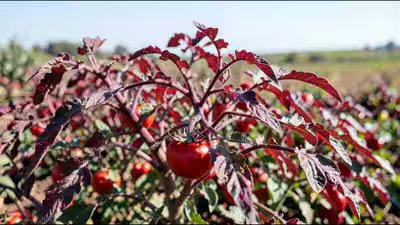
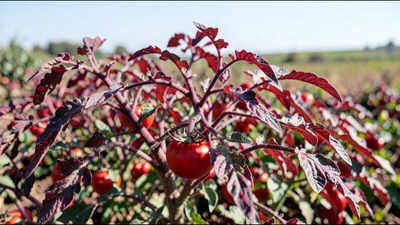
Cornell University scientists have developed genetically engineered tomato plants that turn red-purple when nitrogen becomes scarce, giving farmers a visible warning that crops may need fertiliser. Called RedAlert, the plants have moved beyond greenhouse experiments and are being tested under real-world conditions at Cornell’s Musgrave Research Farm in Aurora, New York. Visitors saw the experiment on July 30 during the 2026 Aurora Farm Field Day, which showcased agricultural research. According to a September report in the Cornell Chronicle, the plants produce betanin, the red-purple pigment found in beets, when deprived of nitrogen. Researchers hope these living sensors could help growers identify nutrient shortages sooner and apply fertiliser more precisely. The plants are not intended to enter the food supply. Instead, they could eventually be planted alongside conventional crops to monitor nitrogen availability in a field.
RedAlert tomatoes : how nitrogen deficiency triggers a red-purple colour change
The project is part of Cornell’s Centre for Research on Programmable Plant Systems (CROPPS), which investigates ways to engineer plants to communicate information about their surroundings. Plant scientist Margaret Frank first conceived the idea behind the colour-changing tomatoes. Initial work on the nitrogen-sensing system involved researchers Brandon Williams and Yinan Wu, while doctoral students Jacob Belding and Ava Forystek developed the RedAlert Living Sensors. Their invention won the Graduate Runner-Up award at the 2025 Collegiate Inventors Competition, receiving $5,000, according to the National Inventors Hall of Fame. RedAlert uses a biological signalling pathway through which plants detect nitrogen availability around their roots and transmit information to their shoots. The engineered plants respond by producing betanin, making nitrogen stress visible through a change in colour.Nitrogen-deficient plants can develop yellowing leaves, but RedAlert is designed to offer a different visual signal that researchers hope could help growers recognise nutrient shortages earlier. In its 2025 report on the invention, the Cornell Chronicle reported that shades of redness reflect varying gradients of available soil nitrogen. However, the researchers are still analysing field data to establish how reliably colour intensity corresponds to nitrogen concentration under real growing conditions. The potential agricultural benefit is reducing unnecessary fertiliser use. Cornell’s 2025 report noted that farmers can apply up to 50% more nitrogen than needed. Excess nitrogen can run off into groundwater and lakes, contributing to harmful algal blooms. A visible biological sensor could help growers identify where fertilizer is needed instead of relying solely on soil measurements that may not capture differences across an entire field.
Cornell’s 2026 field trial tests RedAlert under real growing conditions
The 2026 experiment at Musgrave Research Farm marks the project’s second field season at the site. During the first season in 2025, researchers planted the sensor tomatoes among corn. The plants distinguished low-nitrogen conditions from conditions with sufficient nitrogen. A secondary experiment aimed at using the tomatoes to predict corn yields proved more difficult because the two crops require different management practices. For the 2026 season, researchers established a separate plot containing RedAlert plants alongside non-engineered tomatoes. The experimental plants received 3 nitrogen treatments: a low dose, a standard dose and a recovery treatment that began with low nitrogen before receiving a standard amount.The season presented challenges. Powdery mildew and hot conditions early in the growing period made measuring plant characteristics more difficult. Nevertheless, researchers observed recovery in plants that had experienced early nitrogen stress. Green leaves emerged after nitrogen was added to mature plants, particularly in a new line being tested. Doctoral student Sam Mosher, who is leading the field trials, highlighted the importance of observing recovery in mature plants, which greenhouse experiments rarely grow to that stage. Researchers are analysing soil and leaf samples to investigate whether nitrogen levels explain the observed colour differences.They are also using low-flying drones and handheld spectrophotometers to measure plant colour systematically. The 2026 Cornell Chronicle report noted that visitors asked whether the intensity of the purple-red colour reliably matches nitrogen concentration. Mosher said that if nitrogen proves to be the driver of local colour changes, the new line would be a promising sensor candidate. The field data are still being analysed, so the relationship requires further verification.
Can nitrogen-sensing tomatoes help farmers reduce fertiliser waste?
Researchers hope sentinel plants could provide a more continuous picture of nitrogen availability across agricultural fields. Unlike occasional soil tests, living sensors could potentially reveal changes as plants grow, helping farmers decide when additional fertiliser is necessary. However, practical questions remain unresolved, including how many sentinel plants a field would require and how growers should interpret their colour changes. Visitors at the 2026 field day also raised questions about consumer acceptance and whether the technology could detect other stresses, such as phosphorus deficiency or water shortages. Cornell’s report described these questions as issues that researchers still need to address.RedAlert remains an experimental technology, not a commercially established fertiliser-monitoring system. Its future usefulness will depend on whether further field trials can reliably connect visible colour changes with nitrogen availability under varying growing conditions. For now, the researchers are working to establish that relationship and determine how the plants might fit into practical farm management.