









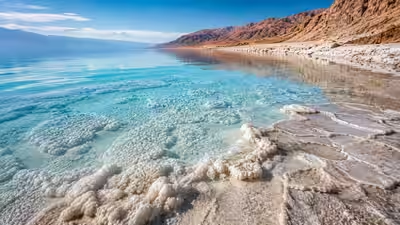
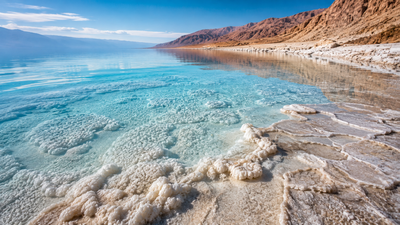
For years, the Dead Sea presented scientists with a genuine puzzle. Its upper waters, warmed by relentless sun and thickened by evaporation, seemed to shed salt each summer rather than accumulate it, while the lakebed far below kept gaining a fresh crust of crystals regardless of season. According to a 2016 study published in Limnology and Oceanography, titled ‘Thermohaline stratification and double diffusion diapycnal fluxes in the hypersaline Dead Sea’, the answer lay in an invisible process called double diffusion, where heat and salt travel across the boundary between layers at very different speeds, driving narrow sinking and rising fingers of water that carry salt downward. Three years later, a separate team led by Ouillon and including Lensky and Arnon put that theory to the test using detailed numerical simulations. Their results backed the original hypothesis, offering a clearer picture of why the Dead Sea floor continues to gain roughly ten centimetres of salt every year.
How salt fingering builds the Dead Sea floor
Double diffusion produces what oceanographers call salt fingering, a process long documented in stratified lakes and oceans. Warm, salty water sits above cooler, less salty water, and at their boundary, narrow plumes or fingers of fluid begin to sink and rise simultaneously. The 2016 paper explained that because heat escapes these descending fingers quickly while their salt content lags, the sinking parcels cool faster than they lose salinity, pushing them towards supersaturation as they plunge into the colder hypolimnion below.The rising fingers experience the reverse effect. As cooler water from below ascends into the warmer upper layer, it gains heat rapidly but retains its lower salinity for longer, becoming undersaturated relative to its new surroundings. Arnon and colleagues described this as an asymmetry unique to saturated brines, noting that the descending fingers become supersaturated and crystallise halite while the ascending fingers become undersaturated and can dissolve it. This asymmetric fingering, they argued, was the missing mechanism linking the seasonal undersaturation observed above with the continuous crystallisation observed below.
Numerical simulations reveal how Dead Sea salt crystals form
The 2016 field study relied on temperature profiling, water sampling and direct observation of crystal growth on a submerged cable, but it stopped short of definitively proving that fingering, rather than some other process, was responsible for the salt transfer. According to the study published in Water Resource Research, titled ‘Halite Precipitation From Double-Diffusive Salt Fingers in the Dead Sea: Numerical Simulations’, using a laboratory-scale water column and high-resolution modelling, the team simulated the fluid dynamics of a warm, salty layer sitting above a cooler, less salty one, both initially at saturation.Their simulations reproduced the same asymmetric pattern predicted three years earlier. The downward propagating fingers lost heat as they moved through the transition zone and became supersaturated, forming crystals, while the upward propagating fingers gained heat and became undersaturated. The authors stated plainly that the simulation confirms the hypothesis of Arnon et al that double diffusive salt fingering results in undersaturated brine in the epilimnion and a mixture of saturated brine and crystals in the hypolimnion. They also found that the convective salt flux ran roughly twice as strong as the heat flux, and that settling crystals reduced the intensity of the effect over time by depleting the sinking fingers of some of their density advantage.
How double diffusion keeps adding salt to the Dead Sea floor
Both studies converge on the same broader conclusion, that the Dead Sea floor gains a substantial layer of halite each year because of this double diffusive pump rather than simple evaporation alone. The 2016 field measurements estimated that the calculated salt flux between layers would produce an average of around seven centimetres of pure salt accumulation on the lake floor over a single stratified season, a figure the authors noted was broadly consistent with earlier annual estimates of about ten centimetres of salt precipitation once winter mixing is included.The 2019 simulation work extended this picture by showing the physical mechanism at the scale of individual fingers, millimetres to centimetres wide, and by demonstrating how factors such as crystal settling velocity and the density relationship between dissolved and crystallised salt shape the rate of precipitation. The authors suggested that these small-scale interfacial processes likely play an important role in the formation of much larger halite deposits found in the geological record, comparing the present-day Dead Sea to ancient evaporitic basins such as those formed during the Mediterranean’s Messinian Salinity Crisis. Together, the two papers form a coherent line of research, from an observational hypothesis in 2016 to a computational confirmation in 2019, that explains why the Dead Sea’s floor continues to thicken with salt even as its surface layer periodically runs short of it.


