









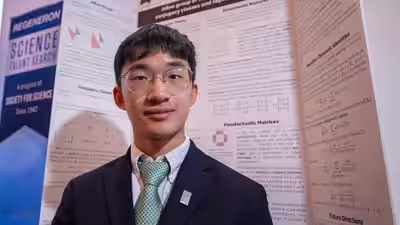
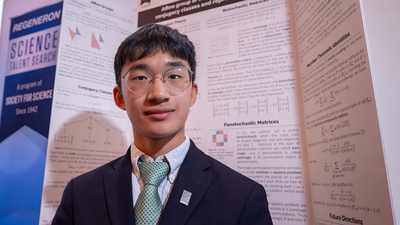
At just 18, Jaeho Lee has already taken on a mathematical problem that reaches far beyond the classroom. A student at Spring Branch Academic Institute in Houston, Texas, Lee was named one of the 40 finalists in the 2026 Regeneron Science Talent Search, after studying the structure of affine permutations. His project, titled ‘Affine Group of Integers Modulo n, Conjugacy Classes and Representations,’ explores mathematical rules that rearrange numbers using multiplication and addition. While the subject may sound abstract, the ideas behind these permutations have connections to practical problems, including highly connected networks and the way heat moves through them. The Society for Science, which profiles Lee as a 2026 finalist, notes that his research focuses on breaking these mathematical structures down into their fundamental building blocks.
18-year-old Texas student Jaeho Lee tackled a surprisingly complex mathematical puzzle
Lee’s research centres on affine permutations, a particular type of mathematical transformation that rearranges elements within a set. These transformations combine multiplication and addition, with the numbers operating under a system where they eventually wrap back around to zero. The Society for Science explains this idea using the familiar logic of a clock, once numbers reach a certain point, they circle back to the beginning. Lee examined collections of these affine permutations and worked to identify their underlying building blocks. That meant looking beyond individual transformations to understand the larger structure created when they are considered together. His work earned him a place among the 40 finalists of the 2026 Regeneron Science Talent Search, selected from more than 2,600 entrants. The competition recognises students whose research demonstrates scientific rigour and the potential to contribute to important areas of knowledge.

His research could have applications beyond pure mathematics (Image: Society for Science/Chris Ayers Photography)
His research could have applications beyond pure mathematics
Although Lee’s project is highly theoretical, its implications are not confined to mathematical textbooks. Affine permutations can be used to understand structures and relationships within complex systems. Simpler forms of the mathematical ideas Lee studied have already helped researchers investigate highly connected networks and examine how heat flows through a network. By calculating the underlying components of sets of affine permutations, Lee hopes his work can contribute to extending those applications.It is precisely that combination of theoretical calculations and real-world significance that makes his project different from other projects. He did not solve an equation, he analysed the system behind the entire category of mathematical objects. This project is the best illustration of how the study of advanced mathematics may begin from simple concepts and find unexpected patterns for future applications.
Jaeho Lee’s interests stretch well beyond mathematics
Lee’s achievements are not limited to mathematical research. Outside his academic work, he is an accomplished violinist and pianist and serves as president of his high school’s symphony orchestra. He also plays classical music for seniors each month through the Music of Harmony club, bringing another dimension to his life beyond science and mathematics. His interest in helping younger students also began early. As a freshman, Lee founded a maths club for fourth- and fifth-grade pupils at a Title I elementary school in Houston, giving younger students an opportunity to explore mathematics. On a lighter note, Lee also enjoys creating his own board games, turning Fridays into family test sessions as everyone plays and offers feedback. At the 2026 Science Talent Search Public Exhibition Day in Washington, D.C., he found the atmosphere among the finalists surprisingly supportive, with students cheering each other on even as they competed for the top honours.


