









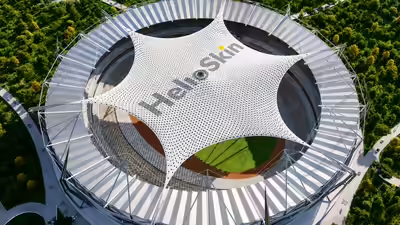
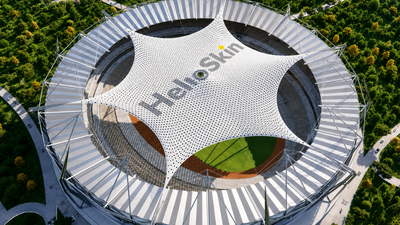
Traditional solar panels have transformed renewable energy, but they come with one major limitation, they are rigid, heavy and designed to sit on flat surfaces such as rooftops or solar farms. That makes them difficult to install on curved buildings, lightweight structures or unconventional designs. Researchers in the United States are now working on a different approach. Using advanced 3D printing, they have developed a flexible solar material called Helio Skin that can bend, stretch and even move in response to sunlight, much like a sunflower. The innovation could allow solar technology to be integrated into buildings and structures where conventional panels simply cannot be used.
What is ‘Helio Skin’ and how does the flexible solar skin work
According to Cornell University, Helio Skin is an experimental solar technology developed by researchers in the United States to make solar energy systems lighter, more adaptable and easier to integrate into everyday architecture. Rather than relying on large, rigid glass panels, the system uses a 3D-printed flexible skin that can conform to curved and irregular surfaces.One of its most distinctive features is its ability to mimic heliotropism, the natural movement seen in plants such as sunflowers, which adjust their orientation throughout the day to maximise exposure to sunlight. Inspired by this biological process, Helio Skin incorporates flexible mechanisms that allow sections of the material to move, helping capture more sunlight without relying on bulky mechanical tracking systems.The prototype combines lightweight materials with programmable structures, allowing the solar skin to stretch, bend and adapt while maintaining its functionality. Researchers believe this biomimetic approach could improve how solar technologies are incorporated into future buildings.
Why Helio Skin could change the future of solar energy
Conventional solar panels are highly efficient but also relatively heavy, often weighing 18 kilograms or more per panel because they rely on rigid glass, aluminium frames and sturdy mounting systems. While this design works well for rooftops and solar farms, it limits where solar technology can be installed and often requires buildings to be designed around the panels rather than the other way round.Helio Skin takes a fundamentally different approach. Because it is lightweight, flexible and capable of adapting its shape, it could one day be wrapped around curved façades, canopies, stadium roofs, transport shelters and other complex architectural surfaces where conventional photovoltaic panels are difficult or impossible to install. Instead of treating solar panels as separate pieces of infrastructure, architects could integrate electricity generation directly into the “skin” of a building.Speaking in an interview about the project, Professor Jenny Sabin from Cornell University said the team wanted to rethink how solar technology interacts with architecture. Rather than asking buildings to accommodate solar panels, they asked how solar systems themselves could become part of a building’s design, adapting to different shapes and orientations while continuing to harvest sunlight. Speaking about the project, she described Helio Skin as a “truly transformative” concept. She said the team set out to develop a system that is adaptive, responsive and multifunctional, allowing renewable energy technologies to blend seamlessly into the built environment rather than being treated as separate additions to buildings.Beyond expanding where solar technology can be installed, Helio Skin could also reduce the need for heavy supporting frameworks, opening possibilities for lightweight structures, temporary installations and architecturally ambitious buildings that currently cannot accommodate traditional solar panels. Although still at the prototype stage, the project points towards a future in which renewable energy systems are no longer added to buildings; they become part of the buildings themselves.
How 3D printing made the solar skin possible
Researchers used 3D-printing techniques to manufacture the Helio Skin prototype, enabling them to create intricate geometric structures that would be difficult or impossible to produce using traditional manufacturing methods. The printed components provide both flexibility and controlled movement, allowing the material to deform without losing its structural integrity.The design draws inspiration from origami, soft robotics and biomimicry, combining engineering with ideas borrowed from nature. By programming the geometry of the material, researchers can influence how it bends and responds to environmental conditions, including sunlight.This approach also allows rapid prototyping, meaning new designs can be tested and refined much more quickly than conventional solar hardware.
Could flexible solar skins become part of future buildings
Although Helio Skin is still a research prototype, it demonstrates how renewable energy technologies are evolving beyond flat rooftop panels. Scientists envision a future in which solar-generating materials are incorporated into building exteriors, public spaces and urban infrastructure, allowing cities to produce clean electricity without requiring additional land.Before commercial deployment, researchers will need to improve the technology’s durability, long-term weather resistance, energy efficiency and manufacturing costs. Even so, Helio Skin highlights how advances in materials science, 3D printing and bio-inspired engineering could redefine the appearance and function of solar power systems.If successful, flexible solar skins may one day enable buildings themselves to harvest sunlight, stretching, bending and even following the Sun to generate electricity in places where traditional panels were never practical.


