









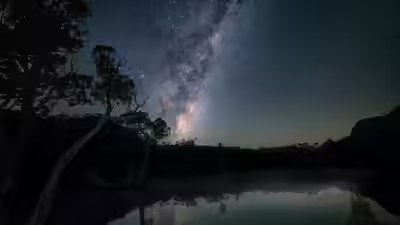
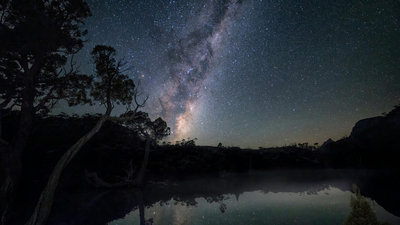
For a few precious months each year, the brightest and most photogenic region of the Milky Way rises high enough above the horizon to create one of nature’s most spectacular night-time displays. June marks the beginning of peak Milky Way season across much of the Northern Hemisphere, offering photographers their best opportunity to capture the galaxy’s glowing core, dense star clouds and intricate dust lanes. Yet photographing the Milky Way requires more than pointing a camera at the sky. Success depends on timing, darkness, weather conditions, camera settings and thoughtful composition. Whether you are using a professional mirrorless camera or a beginner DSLR, understanding how the galaxy moves across the sky can transform an ordinary night photograph into a striking image that reveals our place within the cosmos.
Why June is one of the best months to photograph the Milky Way
The Milky Way is visible throughout the year, but the galaxy’s central bulge, the brightest and most dramatic region for astrophotography, is only visible during specific months.According to the official observing guide from the National Aeronautics and Space Administration (NASA), the galactic centre becomes increasingly prominent during late spring and summer evenings in the Northern Hemisphere, making June one of the most favourable periods for observation and photography.As NASA explains:“The bright core of the Milky Way is visible in summer skies.”The best results occur during the new moon period or when the Moon has set below the horizon. Moonlight can significantly reduce contrast, washing out the faint structure of the galaxy.Researchers from the International Dark-Sky Association note that artificial light pollution has become one of the greatest barriers to observing the night sky. Travelling to a certified dark-sky location dramatically improves visibility and image quality.“Artificial light at night disrupts ecosystems and obscures the stars.”The darker the sky, the more detail your camera will capture within the Milky Way’s dust lanes and star-forming regions.
Essential camera settings for breathtaking Milky Way photographs
Astrophotography relies on gathering as much light as possible while preventing stars from appearing as blurred trails.The Photography Life recommends using a wide-angle lens with the largest available aperture and maintaining careful control over shutter speed.A practical starting point includes:
- Aperture: f/1.4 to f/2.8
- ISO: 1600–6400
- Shutter speed: 10–20 seconds
- Focus: manual, set precisely on a bright star
- File format: RAW
Many photographers use the widely adopted “500 Rule”, developed through practical astronomical imaging experience, to estimate the longest exposure before noticeable star trailing occurs.The formula is:
- Maximum shutter speed = 500 ÷ focal length
- For example:
- 20mm lens = approximately 25 seconds
- 24mm lens = approximately 20 seconds
The European Southern Observatory (ESO), which operates some of the world’s most advanced astronomical facilities, advises photographers to capture images in RAW format because it preserves significantly more data for post-processing.
Best dark-sky locations to photograph the Milky Way
Location can be just as important as camera settings when photographing the Milky Way. Even the most advanced camera equipment struggles in the presence of heavy light pollution, which is why astronomers and astrophotographers often travel to internationally recognised dark-sky reserves and parks. According to DarkSky International and leading astronomy organisations, some of the world’s most reliable Milky Way photography destinations include:
- The NamibRand Nature Reserve in Namibia
- The Atacama Desert in Chile
- The Aoraki Mackenzie International Dark Sky Reserve in New Zealand
- Big Bend National Park in the United States
- Jasper National Park in Canada
- La Palma in Spain’s Canary Islands
- The high-altitude cold desert region of Ladakh in India
These locations are renowned for exceptionally low levels of artificial light, high atmospheric clarity and expansive horizons that allow the Milky Way’s galactic core to be photographed in remarkable detail. Astrophotography experts also recommend seeking out certified dark-sky parks and reserves closer to home using DarkSky International resources, as reducing light pollution remains the single most effective way to improve Milky Way visibility.
How to compose stunning Milky Way images using foreground landscapes
A technically correct image of the Milky Way can still feel ordinary if it lacks a compelling foreground.Professional astronomical imaging projects increasingly combine celestial and terrestrial elements to create a sense of scale and storytelling.Incorporate natural landmarks, mountains, deserts, lakes or historic structures to connect viewers with both Earth and sky.Look for:
- Solitary trees
- Mountain ridges
- Coastal cliffs
- Ancient ruins
- Reflective lakes
- Desert formations
Planning software can also help identify the precise position of the galactic core. Tools developed using astronomical datasets from the European Space Agency’s Gaia mission and other observatories allow photographers to predict where the Milky Way will rise throughout the night.The Gaia mission has mapped more than a billion stars across our galaxy, providing unprecedented information about the Milky Way’s structure and position.As the European Space Agency notes:“Gaia is creating the largest, most precise three-dimensional map of our Galaxy. Gaia’s extraordinarily precise three-dimensional map will provide the data needed to tackle an enormous range of important questions related to the origin, structure and evolutionary history of our galaxy.”The most memorable Milky Way photographs are rarely accidental. They emerge from careful planning, patience and an understanding of the night sky’s rhythms. On a clear June night, far from city lights, the faint band stretching overhead is more than a photographic subject. It is a view from within our own galaxy, a reminder that every star visible to the naked eye belongs to the same vast cosmic system that humans have been observing for thousands of years.


