









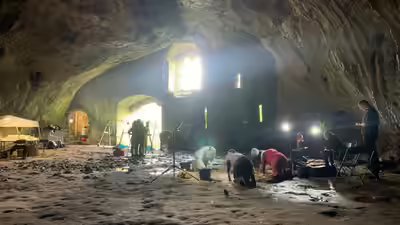
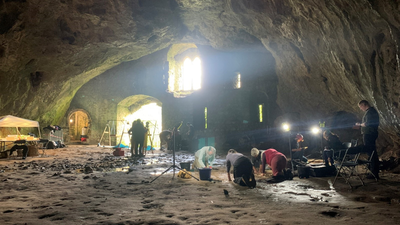
Archaeologists investigating Wogan Cavern beneath Pembroke Castle in Wales say the site could become one of Britain’s most important prehistoric discoveries. Hidden below the 11th-century castle, the cave has revealed evidence of human and animal activity dating back more than 100,000 years. Researchers have uncovered stone tools alongside bones from mammoths, woolly rhinoceroses and hippopotamuses, animals that once roamed prehistoric Britain. Experts from the University of Aberdeen believe the cave may also contain traces of Neanderthals and early Homo sapiens, offering rare insight into Britain’s ancient past.
The hidden ancient cave beneath a Castle
Wogan Cavern is located directly beneath Pembroke Castle, a medieval fortress famous as the birthplace of King Henry VII. The cave can be reached through a spiral staircase inside the castle walls and stretches roughly 23 metres in length, with sections reaching heights of around 10 metres.For many years, archaeologists believed the site held little scientific value because Victorian-era digging was thought to have disturbed much of the original material. That assumption changed when modern excavations revealed intact prehistoric deposits hidden beneath the surface.Researchers say the cave’s size and preservation make it highly unusual compared with many other prehistoric sites in Britain. Excavations carried out between 2021 and 2024 uncovered evidence that humans and animals used the cave across vastly different prehistoric periods. Archaeologists discovered stone tools linked to early humans as well as bones from mammoths, woolly rhinoceroses and hippopotamuses.The hippo remains are especially significant because they likely date back around 120,000 years, during a warmer interglacial period when Britain’s climate looked dramatically different from today. At that time, environments capable of supporting large semi-aquatic animals existed in parts of what is now Wales.Researchers also believe the site may contain traces of Neanderthal occupation alongside evidence linked to early Homo sapiens who lived in Britain between roughly 45,000 and 35,000 years ago.

Pembroke Castle in Wales.
Why archaeologists are excited
According to the research team, the cave may preserve a long sequence of human activity spanning multiple Ice Age cycles. That could help scientists better understand how ancient humans responded to shifting climates, changing landscapes and the arrival or disappearance of different animal species.Dr Rob Dinnis from the University of Aberdeen, who is leading the excavation project, described the site as “truly remarkable” and said there is currently “no other site like it in Britain”.One reason the discovery is considered so important is the quality of preservation inside the cave. Bone fragments, sediment layers and archaeological material appear to have survived in unusually good condition despite centuries of human activity above the site.
A five-year excavation project begins
The new large-scale excavation project is scheduled to begin in late May and will continue for five years. Researchers hope the extended investigation will reveal more complete evidence of prehistoric life inside the cave and help establish a clearer timeline of human occupation.The project is being carried out in partnership with the Pembroke Castle Trust, which plans to keep and display discoveries locally so visitors can learn more about the region’s prehistoric past.For the castle itself, the discovery adds an entirely different layer of history beneath the medieval landmark. While Pembroke Castle is best known for its medieval heritage, archaeologists now believe the ground beneath it may preserve evidence from a world that existed tens of thousands of years before the castle was ever built.


