








Headlines

Meet Lucas Tadao: 14-year-old Brazilian student who turned cassava peels into biodegradable trays that could help replace Styrofoam and reduce plastic pollution |

As concerns over plastic pollution continue to grow, a 14-year-old student in Brazil has developed a sustainable alternative using materials that would otherwise be discarded. Lucas Tadao Sugahara Wernick, a student from Curitiba in the southern state of Paraná, created biodegradable food trays made from cassava peels and araucaria tree residues. Designed as a substitute…

Read More

Quote of the day by Richard Feynman: “The first principle is that you must not fool yourself and…” |

Richard Feynman’s most enduring quote was never intended as a memorable slogan. It came from his 1974 commencement address at the California Institute of Technology, where the Nobel Prize-winning physicist spoke about the principles that should guide scientific research. Among his remarks, one sentence has outlived the rest: “The first principle is that you must…

Read More

In Indian Himalayas, a wild spice is helping 200 families protect 100 sq km of forest while generating an income of Rs 39 lakh

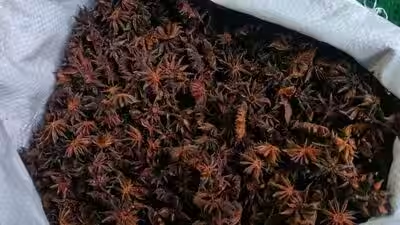
For generations, indigenous communities in Arunachal Pradesh had been using a spice in their food for its citrusy, tongue-tingling flavour. The native plant was a part of their world and that’s all they knew. But today, the small spice is helping 200 families gain a livelihood while also protecting agricultural land.On autumn mornings, residents of…

Read More

Eeg: San Diego student Sharvi Mahajan, 14, designed an EEG-based AI system to predict driver fatigue and microsleep; she is now competing for a $25,000 science prize

Fourteen-year-old Sharvi Mahajan has developed NeuroDrive Alert (Picture: Young Scientist Lab) Sharvi Mahajan, a 14-year-old Indian-American student from California, has been named among the 10 finalists of the 2026 3M Young Scientist Challenge. Mahajan has developed a system to predict driver fatigue before it leads to accidents.Sharvi, an eighth-grade student at Bernardo Heights Middle School,…

Read More

Texas engineers are building fish-like nano-robots that could harvest lithium from seawater and transform the future of clean energy |

Image Credit: Getty Images Lithium is of utmost importance for modern technology. It is powering the smartphones and the huge fleet of electric vehicles. As the world is shifting towards clean energy, the demand for lithium is also increasing quickly, which is placing a huge pressure on land-based mining. However, researchers at Texas A&M University…

Read More

The Southern Ocean may be Earth’s safest place to remove carbon from the atmosphere, scientists find |

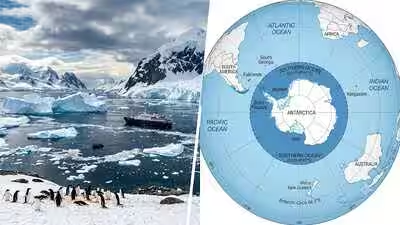
Left/Southern Ocean/Right/Southern Ocean on map/Image: AI Generated As the world searches for ways to remove carbon dioxide already accumulating in the atmosphere, ocean iron fertilisation (OIF) has emerged as one of the most debated climate intervention strategies. The idea is deceptively simple: adding tiny amounts of iron to iron-poor parts of the ocean stimulates the…

Read More

After decades of drought, water is returning to the south of the Sahara Desert as ancient farming techniques and the Great Green Wall breathe new life into the Sahel |

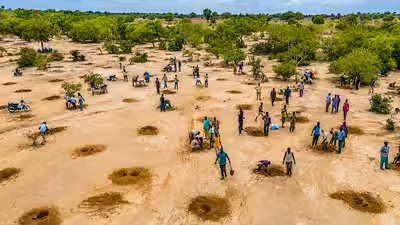
Communities dig water-harvesting pits to restore degraded land and improve soil moisture in the Sahel. For decades, the Sahel has symbolised environmental decline. Stretching nearly 5,900 kilometres across Africa from Senegal on the Atlantic coast to Sudan on the Red Sea, this semi-arid belt has endured recurring droughts, advancing desertification and repeated crop failures since…

Read More